Prototype in days.
Product in weeks.
Lean Software Studio
We build prototypes and production-ready software for startups and mid-sized companies. AI-assisted, signed off by people, GDPR-compliant. The code and the project knowledge are yours.
30 minutes, free. You talk to us directly, not to a sales team.
Book a call
Our fastest client project so far
 Elite Pura Vida RidesBooking systemlive after day 7 at elitepuravida.co.cr
Make premium transfers in Costa Rica bookable online, with fixed prices and no inquiry emails.
In version 1
- Booking flow with fixed prices
- Top routes from SJO and LIR
- Payment and confirmation
- Fleet and vehicle choice
Deliberately later
- Customer account
- Destination pages
- Partner portal
Day 0: One Zoom call. Afterwards scope, routes and fixed prices were settled. Anything that didn't need to be in version one went on a list for later.
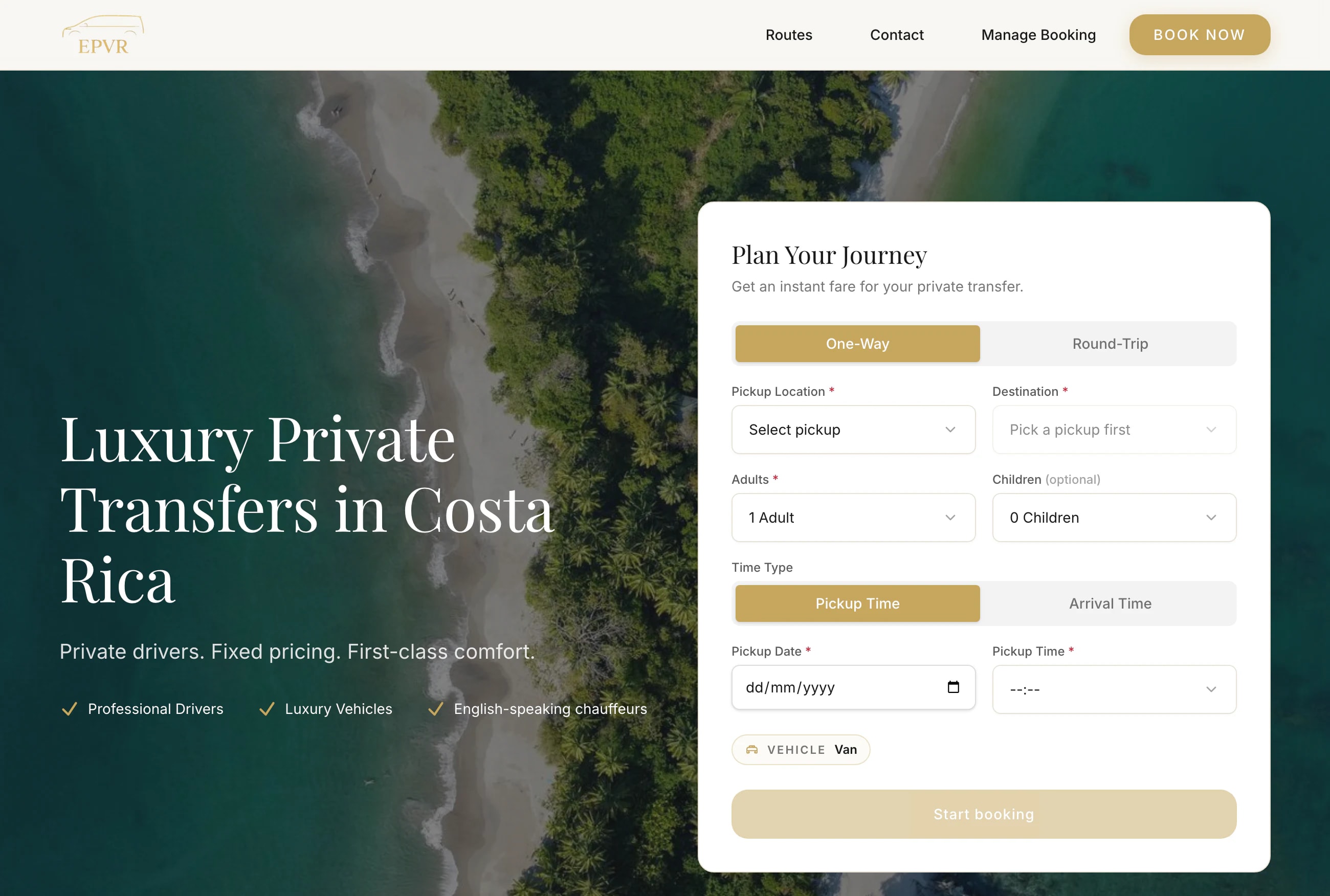
Day 3: Clickable prototype online: pick a route, see the fixed price, start a booking. Three days after kick-off, the client clicked through their own booking flow.
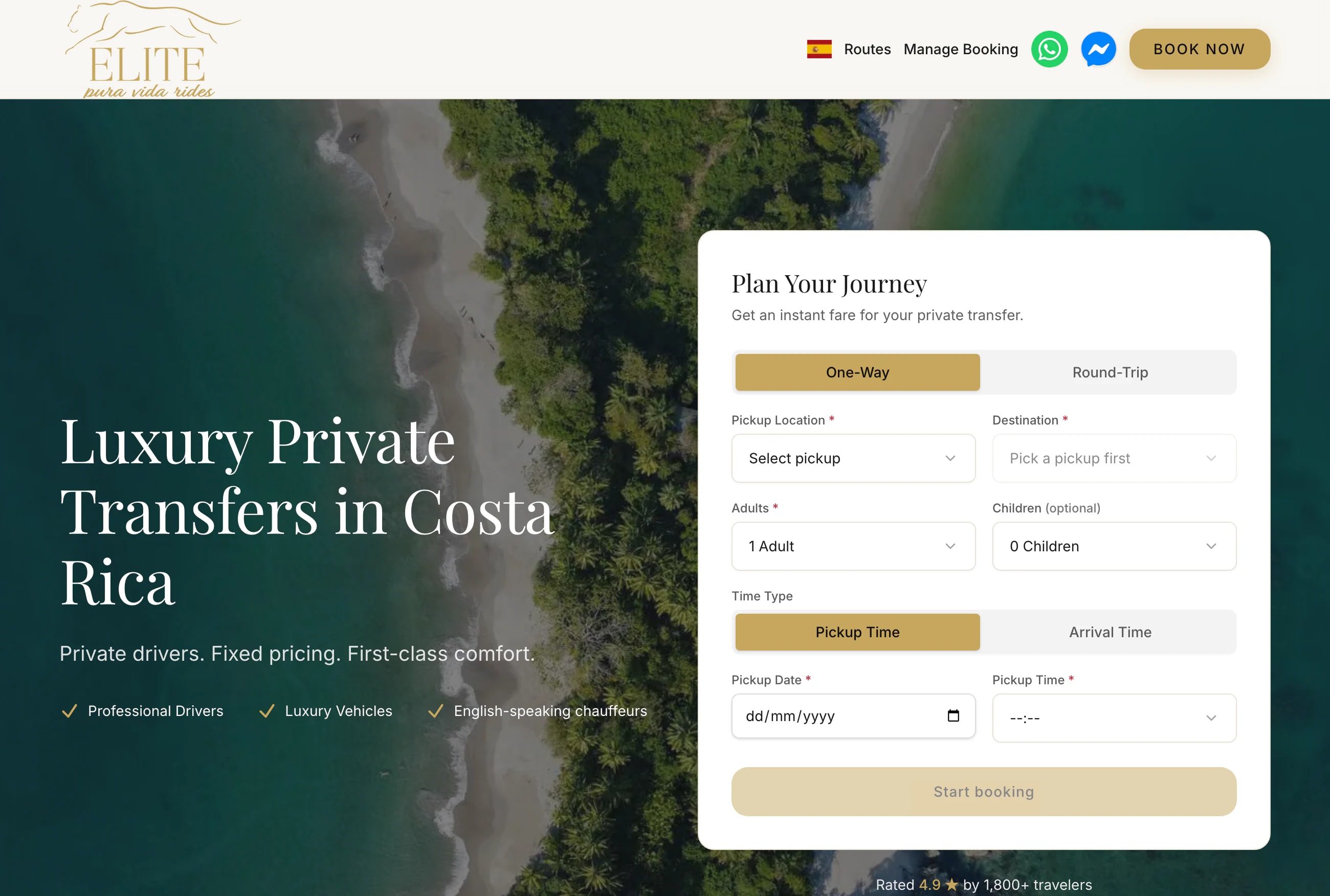
Day 3 to 5: The client's change requests built straight into the prototype. Drag the slider. Structure and code stayed the same, four details changed.
Day 7: MVP live with booking logic, database, scheduling and payments. “Super puntuales y responsables. Los recomiendo 100 %.” A guest on Google about the service the site sells today.
One of our client projects from 2026.
Hall of FameWhat we develop for you.
Want to turn a product idea into reality, improve existing software or renew your digital presence? We take you from the first concrete idea to live operation.
Your product idea becomes an application.
We develop your idea into a digital product. With successive prototypes we test the key flows and build the first usable version step by step.
For example: SaaS applications, platforms, customer portals, custom internal tools.
Your software gains new capabilities.
We extend existing applications, simplify their use and connect further systems. Your software evolves with your requirements.
For example: New modules, better flows, connections to CRM, payments or accounting.
Your business gets the right digital presence.
We build websites and online shops that make your offer clear and lead customers to an inquiry or a purchase. Hosting and support included if you want.
For example: Company sites, booking sites, shops with payment and inventory.
What sets our work apart from an AI prototype.
AI writes the first draft here. Everything that follows is the reason the product runs.
The prototype is the blueprint, not a throwaway.
What you click in days is the same structure that goes live in weeks. Every further loop builds on it instead of starting over.
At Elite Pura Vida Rides, that exact code went live four days later.
AI accelerates. A person signs off.
Every feature is checked by someone on our team. Login, payments and data get an extra approval before anything is built.
For every feature you get the sign-off with name and test evidence.
Decisions, flows and architecture are written down.
You decide open questions in one go, each with our recommendation. Flows, architecture and a complete test and expectation structure are in place before code exists.
Another team could take over tomorrow. That's the point.
GDPR-compliant and accessible, despite the pace.
GDPR compliance and accessibility are met. At the end our own scan confirms security, privacy and accessibility once more from the outside.
Data in Frankfurt. You can run the same scan on any app below, for free.
Clarity first, then code.
We take your idea to a product in three stages: carve out the core, test the experience on a prototype and develop the application step by step. After launch we also take over hosting and support if you want.
Understand & focus
We understand what you want to achieve and what your users need. Together we structure your idea and define the product core for the first usable version.
Result: A shared goal and a clear focus for your MVP.
Design & validate
We make the key flows and the design tangible in a clickable prototype. With your actual users we check what works. In UX Validation Loops we adapt the prototype and add what is still missing.
Result: Flows tested with users, a clear scope and a binding fixed-price quote.
Develop & expand
With a Code Prototype we check technical feasibility and key integrations. On that we build: in agreed Prototype Loops we extend, test and refine the application up to the MVP you can take to market.
Result: A ready-to-use MVP that can keep growing afterwards.
Operations
Hosting in Europe, technical monitoring, updates and maintenance at a monthly fixed price. We agree the scope to fit your product. New features and larger extensions are agreed separately.
Result: A supported product with clear responsibilities and predictable running costs. Code and project knowledge are yours.
Why not just vibe code it yourself?
You can. For a weekend idea it's the right way, and we often recommend it. The difference starts as soon as real users, payments or data are involved.
Show comparisonHide comparison
Scope
Built yourself with AI: The AI builds what you describe. You notice what's missing with the third user.
With decivo: Before the first prompt it's settled what goes into version one and what deliberately doesn't.
Checks
Built yourself with AI: It looks finished. Whether login, failure cases and privacy hold up shows in production.
With decivo: Tests before code, including failure cases. Login, payments and data get an extra approval.
Users
Built yourself with AI: You test with yourself. The AI doesn't push back.
With decivo: Your users click through the prototype before anything is built. Every piece of feedback is tied to a version.
Knowledge
Built yourself with AI: Decisions live in the chat history. Three weeks later nobody remembers why something is the way it is.
With decivo: Flows, decisions and architecture are documented. Another team could take over.
When something breaks
Built yourself with AI: You keep prompting and hope. Often the code grows until nobody understands it.
With decivo: A person signed off every feature and knows the code. Maintenance and hosting by us, if you want.
Already built something? Our scan shows you where the gaps are, for free. If it's worth it, we build on it instead of starting over.
Scan your own appWhere are you right now?
Pick your starting point. Below you'll find the matching package with its result and fixed price.
Entry points
Fits if you have an idea but it's still open what belongs in version one.
Includes UX concept and Clickable Prototype.
Fits if goals and core features are set and you want to try, present or user-test your product idea.
Next up: UX Validation Loop (optional loop) or Code Prototype (next package)
Fits if you want to grow your clickable prototype and validate the new flows with users.
Only together with the Clickable Prototype.
Fits if the key user journeys are tested and you want to build a first working version.
Also possible starting from a suitable prototype by your designer or agency. For comparison: MVP development costs €40,000 to €80,000 on average.
Fits if your first version runs and you want to grow it step by step into an MVP or a fuller product.
Only together with the Code Prototype.
All prices are fixed for the agreed scope, excl. VAT.
Already have a design or prototype? Together we check what we can build on and which step makes sense next.
Clarify in the first call80 %
For prototypes and early-stage projects, up to 80 % funding is possible in some cases.
How much depends on the federal state, programme and company status. We check in the first call whether it applies to you. We don't promise funding.
Who works with you.
No sales team. Straight to the experts. From the first call you work with the three people who plan, design and build your product.

Tobias Zubler
Product strategy and scope
Brings direction to projects where it's still open what gets built first.
LinkedIn Tobias Zubler, opens in a new window
Jacqueline Hares
Design and brand
Turns product logic into interfaces users understand without explanation.
LinkedIn Jacqueline Hares, opens in a new window
Janni Hares
Architecture and AI systems
Decides how the system is built and owns the quality of the code.
LinkedIn Janni Hares, opens in a new window
Tools you can use today.
Free, no sign-up
decivo Scan
Enter your app's address and get results in minutes: security, privacy, accessibility and architecture. Every finding shows what we base it on.
- AI apps in DACH scanned
- 442
- need rework
- 80%
- production-ready
- 20%
What to know before you get in touch
Why does a prototype cost €3,500 if AI helps?
AI is a fixed part of how we work and lets us reach concrete results faster. You get our experience in product development and UX, clear user journeys and an individually crafted clickable prototype. We take care of concept, execution and quality review, at the agreed fixed price.
Can we keep building without you afterwards?
Yes. You get the prototype at its own link and the source code. You can test with it, align internally or hire another team. Code, documentation and decisions are yours.
Do you build the finished product too?
Yes. We take you from the first prototype through the MVP to the finished product. In clearly agreed build steps we add features, develop the UX further and check quality. Every step builds on the current state, with a fixed scope and fixed price.
Do you also handle hosting and operations?
Yes. If you want, we take over hosting in Europe, updates and maintenance at a monthly fixed price. We handle the technical operation and remain your contact after launch. Code and project knowledge are yours, switching to another provider stays possible.
30 minutes to put your project in the right place.
Honest assessment, start within days.