How we work
Clarity first,
then code.
We take your idea to a product in three stages: work out the core, test how it is used with a prototype and build the application step by step. After launch we can also take care of hosting and support.
Understand & focus
We understand what you want to achieve and what your users need. Together we structure your idea and define the product core for the first usable version.
First call
We clarify goals, users, risks and how you measure success. Open assumptions get named, not glossed over.
Structuring requirements
What you want to achieve, which problem the product solves and who will use it. This becomes an ordered list instead of a loose collection of wishes.
Defining the product core
Together we work out what belongs in the first usable version and what deliberately comes later. This core later becomes the MVP.
Make premium transfers in Costa Rica bookable online, with fixed prices and no enquiry emails.
Product core, version 1
- Booking flow with fixed prices
- Top routes from SJO and LIR
- Payment and booking confirmation
Deliberately later
- Customer account
- Destination pages
- Partner portal
Result: a shared goal and a clear focus for your MVP.
Design & validate
We make the key flows and the design tangible in a clickable prototype. With your actual users we check what works. In UX Validation Loops we adapt the prototype and add what is still missing.
Clickable prototype
Within a few days the product core becomes your prototype in the browser, with real flows instead of slides. Every version gets its own link.
Testing with users
You and your actual users click through workflows, navigation and design. Every piece of feedback is linked to the version it refers to.
UX Validation Loops
Based on the feedback we adapt the prototype, add further topics and user journeys and test the changes with users again. As many loops as your project needs.
Open questions, decided together
Whatever is still open comes to you on one list, each question with our recommendation. That way there are no surprises halfway through.
A binding fixed-price quote
We break the project into tasks and estimate each one, based on measured values from our past projects. That becomes a binding fixed-price quote for the agreed scope.
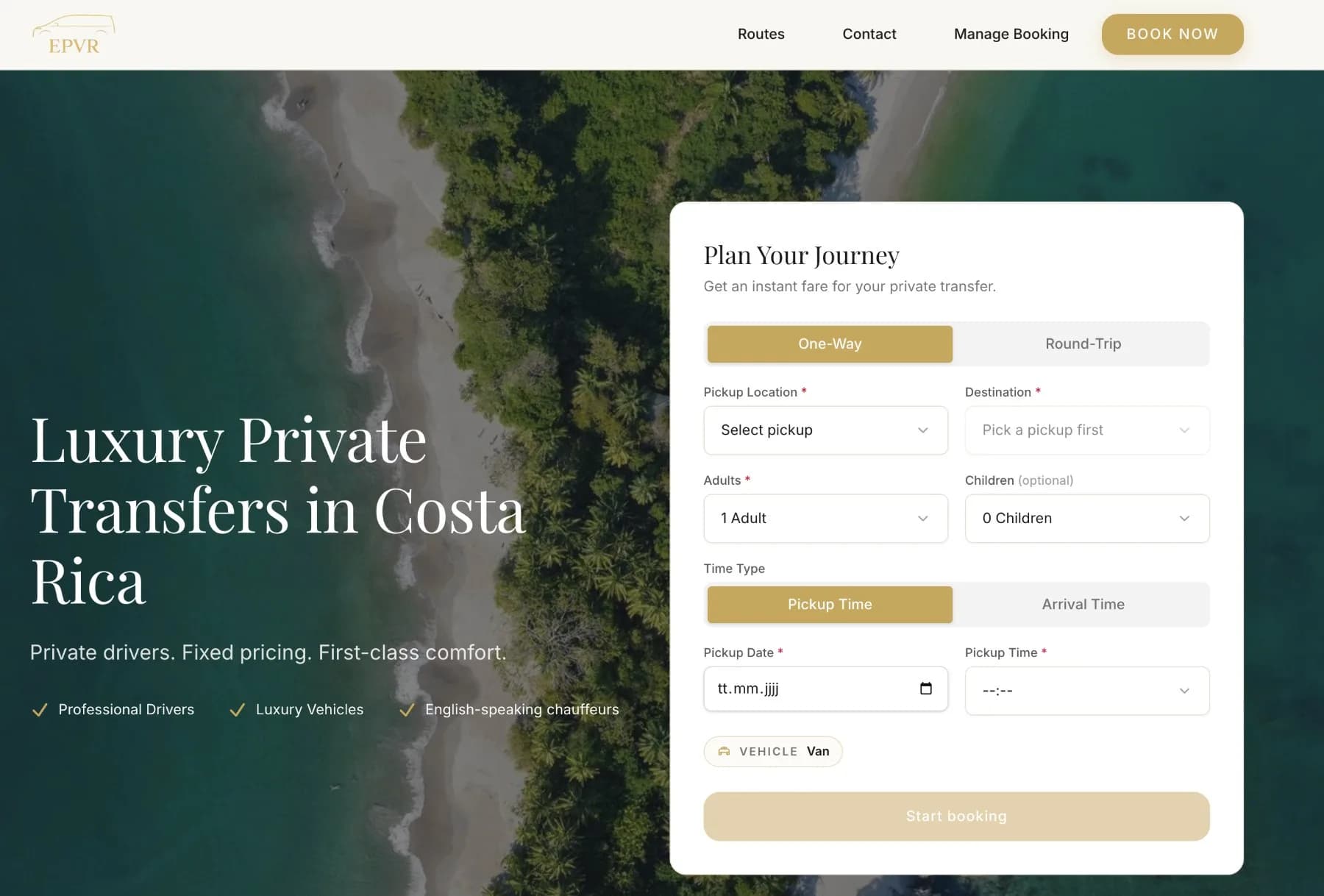
Open questions, round 1
Do guests need an account?
Recommendation: no, booking via email confirmation. Account later.
Pay upfront or on site?
Recommendation: upfront online, free cancellation up to 48 hours before.
Which languages at launch?
Recommendation: English and Spanish.
Estimate per task
- Booking flow
- 3 to 4 days
- Payment and cancellation
- 2 to 3 days
- Calendar sync
- 1 to 2 days
- Admin for routes and prices
- 2 to 3 days
- Total
- 8 to 12 days
Result: flows tested with users, a clear scope and a binding fixed-price quote.
Build & expand
With a Code Prototype we check technical feasibility and key integrations. Then we build on it: in agreed Prototype Loops we extend, test and refine the application up to the MVP you can take to market.
Code Prototype
The technical foundation. We turn the core features of the tested prototype into working software and check feasibility, architecture and key integrations.
Prototype Loops up to the MVP
In agreed expansion steps we add features and workflows on the same codebase, test them and sign them off together with you. How many loops are needed depends on the agreed MVP scope.
A clear description per feature
Before each feature it is settled what your users experience, what is explicitly out of scope and when it is done.
Tests before code
First we write the checks, including for failure cases. An independent review adds what is missing. Then the code is written, AI-assisted with Claude and owned by us. Login, payments and data get an extra approval before we build.
Signed off by people
Every feature is checked and signed off by a person, with a live preview and proof that the tests pass.
Product launch
Once the agreed MVP scope is signed off, the application goes live, in Europe, with your data in Frankfurt (GDPR).
Feature: pay for booking
- What users experience
- The guest pays the fixed price by card and gets a confirmation right away.
- Out of scope
- Vouchers, instalments
- Done when
- Payment, failure and cancellation work and are confirmed.
Result: a ready-to-use MVP that can keep growing afterwards.
Operation
If you like, we take over hosting in Europe, technical monitoring, updates and maintenance for a fixed monthly price. We agree the scope to fit your product. New features and larger extensions are agreed with you separately.
Hosting in Europe
Hosted in Europe, database in Frankfurt. If you later want to move to your own servers, that works without a rebuild.
Monitoring and updates
We monitor availability and errors, apply security updates and keep dependencies current.
Maintenance at a fixed price
Small changes and fixes are included in the fixed monthly price. The scope is in the quote upfront. Larger extensions run as Prototype Loops.
Result: a supported product with clear responsibilities and predictable running costs. Code and project knowledge belong to you.
Our principles
See before you build
Prototype and flows are settled before development starts.
Decisions in one place
You decide deliberately, not in passing.
Tests first
Every feature is checked before it goes live.
A person signs off
AI helps build, we are accountable.
Fixed prices
Binding fixed prices, based on real measurements.
Data in the EU
Hosting in Europe, database in Frankfurt.
GDPR and accessibility are part of the tests
Both are checked before every feature, not at the end.
You own everything
Code, documentation, decisions.
Questions about the process
Do we always have to start with the first stage?
No. If you already have a clear scope or a design, we start right at the prototype. Design & validate and Build & expand then run as described.
What do we get at the end of each stage?
After Understand & focus, a shared goal and a clear focus for your MVP. After Design & validate, flows tested with users, a clear scope and a binding fixed-price quote. After Build & expand, a ready-to-use MVP that can keep growing afterwards.
How is the fixed-price quote put together?
We break the project into tasks and estimate each one, based on measured values from our past projects. That becomes a binding fixed-price quote for the agreed scope. You see what is included before you sign.
How many Prototype Loops does it take to reach the MVP?
That depends on the agreed MVP scope. Every loop adds features and workflows on the same codebase, is tested and signed off together with you.
What role does AI play in development?
The code is written AI-assisted with Claude, and we are accountable for it. Tests come before the code, and every feature is checked and signed off by a person.
Who runs the software after launch?
We can: hosting in Europe, technical monitoring, updates and maintenance for a fixed monthly price. If you later want your own servers, that works without a rebuild.
Already have a clear scope or a design? Then we start right at the prototype.
30 minutes, an honest assessment, start within days.