What is an MVP? Definition, Examples & Step-by-Step Guide
90% of startups fail — and the most common reason is a product nobody needs. An MVP prevents exactly that. In this guide you will learn what a Minimum Viable Product really is, how to build your own MVP in 6 steps, and which mistakes you should absolutely avoid.
An MVP (Minimum Viable Product) is the simplest version of a product that gives real users enough to test one central assumption — usually: does this solve a problem someone is willing to pay for? An MVP is therefore not a half-finished product but a learning instrument. The benchmark is not the least functionality but the maximum validated learning for the least effort (Eric Ries, The Lean Startup, 2011).
TL;DR — the 5 key takeaways
- MVP = the smallest product version that delivers maximum validated learning with minimal effort (Eric Ries, The Lean Startup, 2011).
- Dropbox used a 3-minute video in 2008 and jumped from 5,000 to 75,000 signups overnight (Drew Houston in the TechCrunch interview).
- Buffer validated its idea in 2010 with a 2-page landing page — first paying customer after 3 days (Joel Gascoigne).
- According to CB Insights, 43% of analyzed startups fail due to missing product-market fit — the very problem an MVP surfaces early.
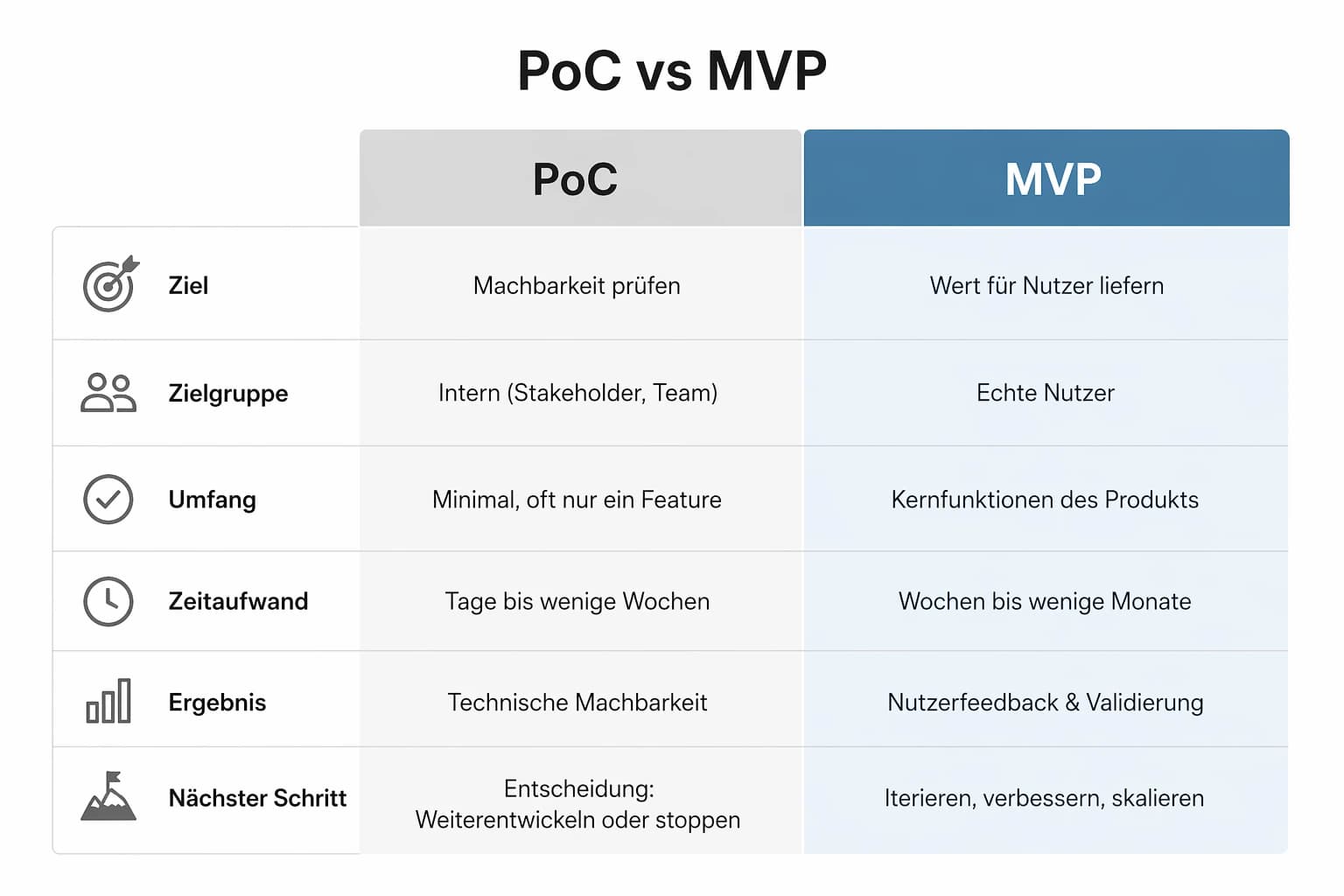
- MVP ≠ PoC ≠ prototype. PoC proves feasibility, the prototype validates UX, the MVP tests willingness to pay.
What does MVP mean?
MVP stands for Minimum Viable Product — the simplest version of a product that provides just enough functionality to be tested by real users and generate valid feedback.
A common misconception up front: An MVP is not a half-finished or low-quality product. It is a strategic tool for testing a core hypothesis — namely whether your product solves a real problem that people are willing to pay for.
Eric Ries, who popularized the term in his book The Lean Startup (2011), defines an MVP like this:
“A Minimum Viable Product is that version of a new product which allows a team to collect the maximum amount of validated learning about customers with the least effort.”
The keyword here is validated learning. The point is not to build as little as possible — it is to learn as quickly as possible (see Ries’s original Minimum Viable Product Guide, 2009).
Origins and history of the MVP concept
The MVP idea has its roots in the lean-startup movement and has evolved over two decades:
Frank Robinson
Coins the term “Minimum Viable Product” in the context of the SyncDev methodology. He emphasizes that an MVP should deliver the highest return on investment relative to risk.
Steve Blank
Describes the Customer Development Process in The Four Steps to the Epiphany — the methodological foundation on which MVP development is built.
Eric Ries
Makes the concept world-famous through The Lean Startup and establishes the Build-Measure-Learn cycle as the standard toolkit for startups and innovation teams.
Industry standard
The MVP approach is no longer limited to startups. Corporations like Siemens, Bosch, and Deutsche Telekom use MVP methods in their innovation departments. AI-assisted development has lowered the barrier to entry even further in 2025/2026.
Why you need an MVP
The core problem: Roughly 90% of startups fail. The most common reason? They build a product nobody needs. According to CB Insights, 43% of analyzed startups fail due to missing product-market fit — the single most-cited cause across 431 post-mortems. An MVP solves this by testing the costliest assumptions first.
The Build-Measure-Learn loop
The MVP sits at the heart of the Build-Measure-Learn cycle — the core process of the lean-startup method:
Build
Create the simplest version of your product that makes your core hypothesis testable.
Measure
Collect quantitative and qualitative data from real users — not surveys among friends.
Learn
Evaluate the results and decide: continue, adjust, or pivot?
This cycle is run iteratively — as fast and as cheaply as possible. Each iteration brings you closer to a product the market actually wants.
Key benefits of an MVP
Risk reduction
Instead of investing 6–12 months and €100,000+ into a full product, you test your idea in weeks for a fraction of the budget.
Faster time to market
Time-to-market is decisive. Whoever gets real user feedback first can iterate faster than the competition.
Data-driven decisions
Instead of relying on gut feeling, you make product decisions based on actual user data.
Convince investors
A working MVP with early traction metrics is more convincing to investors than any pitch deck.
Cost savings
The MVP method can reduce development costs by up to 60% — because you learn early what you do NOT need to build.
Focus on the core
An MVP forces you to identify the one core feature that makes your product valuable. Everything else is nice-to-have.
MVP vs. Prototype vs. PoC vs. MMP: What is the difference?
Many terms circulate in product development — and they are often confused. Here is the clear distinction:
| Concept | Goal | Audience | Functionality | Duration |
|---|---|---|---|---|
| Proof of Concept (PoC) | Verify technical feasibility | Internal team | Minimal, core function only | 1 – 2 weeks |
| Prototype | Validate design & UX | Stakeholders, test users | Visual, not functional | 2 – 4 weeks |
| MVP | Test a market hypothesis | Real users / customers | Core function, usable | 4 – 12 weeks |
| MMP | Generate first revenue | Paying customers | Market-ready, polished | 3 – 6 months |
| MLP | Drive user engagement | Early adopters | Emotionally compelling | 4 – 8 months |
Important: These concepts are not mutually exclusive. In practice you often follow a sequence: PoC → Prototype → MVP → MMP. The prototype helps you find the right UX. The MVP tests whether the market wants your solution. If you are at the prototype step and unsure whether a clickable Figma prototype is enough or you really need code: our decision matrix on clickable vs. code prototype sorts it out in four minutes. (For a deeper breakdown, see UXPin — Prototype vs. MVP vs. PoC.)
What an MVP is NOT: The 7 most common mistakes
Most MVP projects don’t fail because of technology — they fail because of wrong assumptions about what an MVP is supposed to be. Here are the most common misconceptions:
“An MVP is a bad product”
Wrong. An MVP must solve the core function well. It has fewer features, but the ones it has work flawlessly. Users forgive missing features — but not a broken core function.
“Let’s just build first and see what happens”
An MVP without a clear hypothesis is not an MVP — it’s an experiment without measurement. Define upfront: what exactly do you want to find out? Which metric proves or disproves your assumption?
“Our MVP needs all the planned features”
That’s no longer an MVP — it’s a V1. Ruthlessly cut everything that doesn’t contribute to the core hypothesis. Most successful MVPs ship with 20–30% of the features originally planned.
“MVPs are only for startups”
Corporates and mid-size companies benefit enormously too. Bosch, Siemens, and Telekom use MVP approaches in their innovation programs. The principle works wherever uncertainty exists.
“The MVP is the final product”
An MVP is a learning tool. It is meant to generate data, not immediate revenue. Don’t cling to the MVP — iterate based on your findings toward the next level.
“We don’t need user feedback”
Then you don’t need an MVP either. Feedback IS the purpose. An MVP without real users is like an experiment without measurement — pointless.
“The cheaper, the better”
An MVP that is built so poorly that users can’t operate it produces no actionable data. Quality in the core function is mandatory — save on scope, not on quality.
MVP examples: From startups to mid-size companies
International classics
Dropbox (2008)
Drew Houston knew that a working file-sync service would be extremely complex to build. His MVP? A 3-minute explainer video showing how the finished product would work. Result: the waitlist exploded overnight from 5,000 to 75,000 sign-ups — without a single line of production code (Drew Houston in the TechCrunch interview).
Airbnb (2007)
Brian Chesky and Joe Gebbia couldn’t make rent. Their MVP? Air mattresses in their own apartment and a simple website with photos. Three guests booked on the first try. The hypothesis was validated: people will pay to stay with strangers.
Spotify (2006)
The Swedish team launched a desktop client with just one function: stream music with zero delay. No social features, no playlists, no recommendations. Just press play and hear music instantly. The core hypothesis: streaming beats downloads.
Instagram (2010)
Started as “Burbn” — a check-in app packed with features. The founders discovered through their MVP that users almost exclusively used the photo feature. They cut everything else, focused on photos + filters — and were acquired for $1 billion within two years.
German and European examples
N26 (2013)
The Berlin-based neobank started with a simple prepaid Mastercard and an app that only tracked expenses. No transfers, no savings accounts, no loans. The first test was simple: do young Germans want a bank that runs entirely on mobile?
FlixBus (2013)
Launched with just a handful of bus routes between German cities and a basic booking website. The MVP tested a clear hypothesis: is there demand for affordable long-distance bus travel in Germany after market deregulation?
Zalando (2008)
The founders photographed shoes in Berlin stores and listed them online — without any inventory of their own. When orders came in, they bought the shoes themselves and shipped them. A classic “Wizard of Oz” MVP that proved demand.
Building an MVP: Step-by-step guide
From idea to validated MVP in 6 clearly defined steps. Each step delivers a concrete outcome that informs the next.
Define the problem and target audience
Before you write a single line of code or create a design: What specific problem does your product solve? And for whom?
Use these questions as a guide:
- Who is your target audience? (Be specific — not “all SMEs” but “SaaS founders with 5–20 employees”)
- What problem do they have? (Measurable and concrete)
- How do they solve the problem today? (The current solution is your real competitor)
- Why is the current solution unsatisfactory?
Formulate your core hypothesis
Every MVP needs a clear, testable hypothesis. Frame it like this:
“We believe that [target audience] has the problem [problem] and is willing to use/pay for [solution] because [reason].”
Example: “We believe that solo freelancers have the problem of messy bookkeeping and are willing to pay €19/month for an AI-powered accounting app because existing solutions are too complex.”
Choose the right MVP type
There are several MVP types — pick the one that fits your hypothesis:
Landing Page MVP
A landing page describing your product with a “Buy now” or “Join the waitlist” button. Measures interest before anything is built. Buffer landed its first paying customer this way in 3 days.
Concierge MVP
You solve the customer’s problem manually and personally. No technology needed. This way you understand the process before automating it.
Wizard of Oz MVP
Users see a finished product — but behind the scenes you do everything manually. Tests demand without technical infrastructure. The classic: Zappos founder Nick Swinmurn photographed shoes in stores in 1999 before investing.
Single-Feature MVP
A functional piece of software with exactly one core feature. Nothing more, nothing less.
Video MVP
A video showing how the finished product would work — just like Dropbox demonstrated.
Crowdfunding MVP
Put your concept on Kickstarter or Indiegogo. The funding rate is your validation.
Identify core features
List every planned feature. Then evaluate each one rigorously:
- Essential for testing the hypothesis? → Keep it.
- Nice-to-have? → Cut it.
- Can it be added later? → Cut it.
Be brutally honest. Most successful MVPs ship with 20–30% of the features the team originally envisioned. Less really is more here.
Build, test, measure
Now it’s time to build — with speed as the guiding principle. Use the modern tools available in 2026:
- No-Code/Low-Code: Bubble, Webflow, FlutterFlow for rapid prototypes
- Rapid Development: Next.js, Supabase, Vercel for functional MVPs
- Design: Figma for prototypes, Maze for UX testing
- AI-assisted development: Claude Code, Cursor for 3–5x faster development
Define your success metrics before launch: conversion rate, usage rate (DAU/MAU), Net Promoter Score, willingness to pay, retention after 7/30 days. Pick the single metric that most directly tests your core hypothesis.
Evaluate and decide
After 2–4 weeks of live testing, you have data. Three paths lie ahead:
Persevere
The data confirms your hypothesis. Continue building toward an MMP.
Pivot
The data reveals an opportunity in a different direction. Adjust your hypothesis.
Kill
The data disproves the hypothesis. And that’s okay — you learned it in weeks, not years.
Building an MVP with AI: The 2026 workflow
MVP development has changed fundamentally in 2025/2026. AI-powered tools make it possible to create functional MVPs in a fraction of the time it used to take. Paul Graham framed the mindset early on: Do Things that Don’t Scale (2013). Here is what that means for you today:
The modern AI stack for MVP development
Design & Prototyping: Figma with AI plugins generates UI layouts in minutes instead of days. Tools like Figma Make turn design ideas directly into interactive prototypes — no design background required.
Code development: AI-powered development tools like Claude Code and Cursor enable you to build functional software 3–5x faster. Complex features that used to take weeks now emerge in days.
Backend & Infrastructure: Platforms like Supabase, Vercel, and Railway offer ready-to-use backends with authentication, databases, and API hosting — zero DevOps overhead.
Validation: Automated A/B tests, heatmaps, and AI-driven feedback analysis shorten the learn cycle from weeks to days.
What does this mean for your MVP budget?
What cost €50,000–€80,000 two years ago can often be done today for €15,000–€30,000 — with better quality and faster delivery. The barrier to validating your business idea has never been lower.
At decivo we use exactly this AI-powered workflow: we combine strategic clarity (what exactly needs to be validated?) with modern technology (how do we build it fastest?). The result is MVPs that stand in weeks instead of months — and deliver real market data.
MVPs across industries
The MVP approach works across industries — but execution differs depending on the context:
Healthcare / MedTech
MVPs are subject to regulatory requirements (MDR, GDPR). Concierge or Wizard-of-Oz approaches are especially well suited to test demand before costly certification.
Fintech
N26 showed the way: start with one core function and secure the banking license in parallel. Regulation is not a roadblock when planned strategically.
SaaS / B2B
Single-feature MVPs are the standard. Focus on the one workflow that addresses your customers’ biggest pain point. Enterprise clients accept reduced feature sets when the core is compelling.
Physical products
3D printing and crowdfunding (Kickstarter, Indiegogo) enable physical MVPs with minimal capital. Test demand before committing to mass production.
Enterprise / Corporates
The MVP approach also works internally: build an internal prototype, test it with one department, and scale to the entire organization only after validation.
Service businesses
Services are ideal for concierge MVPs. Deliver the service manually, measure demand and satisfaction, and automate only afterwards.
Sources
Every figure in this article comes from the publications below. Where we use our own data, the study is named in the text.
- Eric Ries — Minimum Viable Product: a guide (Startup Lessons Learned, 2009)
- Eric Ries — The Lean Startup: Principles (2011)
- TechCrunch — Dropbox startete mit einem Minimal Viable Product (2011)
- Fortune — Nick Swinmurn, der stille Zappos-Gründer (2012)
- Joel Gascoigne — How to successfully validate your idea with a landing page MVP (Buffer)
- CB Insights — The Top 12 Reasons Startups Fail
- Paul Graham — Do Things that Don't Scale (2013)
- UXPin — Prototype vs. MVP vs. Proof of Concept
Everything you need to know about MVPs
What is an MVP in simple terms?
An MVP (Minimum Viable Product) is the simplest version of a product that offers just enough functionality to be tested by real users. The goal: find out as quickly as possible whether your product idea solves a real problem — before you invest significant time and money.
How long does it take to build an MVP?
Depending on complexity and MVP type, development takes between 2 and 12 weeks. A landing-page MVP can go live in a few days. A functional software MVP with one core feature typically takes 6 to 12 weeks. Modern AI tools and no-code platforms can shorten these timelines significantly.
How much does an MVP cost?
Costs vary widely: a landing-page MVP costs under €1,000. A no-code MVP runs €3,000 to €10,000. A functional software MVP typically costs €15,000 to €50,000. The deciding factors are MVP type and core-feature complexity. Thanks to AI-assisted development, costs in 2026 are considerably lower than two years ago.
What is the difference between an MVP and a prototype?
A prototype is a visual model for validating design and UX — it is not functional and is not used by real customers. An MVP, on the other hand, is a working product version used by real users to test a market hypothesis. The prototype often comes before the MVP.
Who should build an MVP?
MVPs are ideal for startups seeking product-market fit, SMEs exploring new business areas, corporations with innovation programs, and freelancers validating their own product ideas. Essentially, anyone bringing a new product or feature to market benefits from the approach.
What is the difference between an MVP and an MMP?
An MVP tests whether a market exists — the focus is on learning. An MMP (Minimum Marketable Product) is the first version that can actually be sold — the focus is on revenue. The MMP typically builds on insights gained from the MVP.
Can you build an MVP without coding skills?
Yes. Many MVP types require no code at all: landing pages (Webflow, Carrd), forms (Tally, Typeform), concierge MVPs (manual service), or video MVPs (like Dropbox). For functional software MVPs, no-code platforms such as Bubble or FlutterFlow are available. Alternatively, you can partner with a specialized studio like decivo.
When has an MVP failed?
An MVP hasn’t failed if it shows your idea doesn’t work — that’s valuable learning. An MVP fails when it yields no actionable data: when you had no clear hypothesis, measured the wrong metrics, or reached too few users to draw reliable conclusions.
Which metrics should you track for an MVP?
The most important metrics are: conversion rate (how many visitors become users?), activation rate (how many users experience the core value?), retention (do users come back?), Net Promoter Score (would they recommend it?), and willingness to pay. Pick the single metric that most directly tests your core hypothesis.
What comes after the MVP?
After the MVP you have three paths: continue and evolve into an MMP if the data confirms your hypothesis, pivot if the data reveals a different opportunity, or shut it down if the market doesn’t need the solution. Either way, you’ve gained maximum clarity with minimal investment.
Related articles
- MVP basics
Clickable Prototype or Code Prototype? Decision Matrix for Founders 2026
Clickable Figma prototype or working code? Risk-based matrix, five anti-patterns, and clear guidance on which format answers which question — from a studio that ships both.
- MVP basics
Validating Your Business Idea 2026: 6 Methods That Work
Validation in 6 stages: desk research to MVP, hard benchmarks, The Mom Test, decision flowchart, and 2026 AI tools.
- Building an MVP
What Does an MVP Cost? Having an MVP Built in 2026: Real Prices, Not Ranges
The AI price break: why MVPs are cheaper in 2026 than 2024, traditional agency vs. AI-native studio per MVP type, published fixed prices instead of hourly ranges — plus an interactive cost calculator.
Ready to validate your idea?
We help you find out in weeks, not months, whether your product works in the market. In a free initial consultation we analyze your starting point and recommend the right next step.
Clearly structured. No sales pressure. Ready to start in days.