Validating your business idea: how to know whether it actually works
The only practical guide that names all six validation methods, delivers hard benchmarks, and shows how to get real clarity in 7 to 14 days in 2026 — before the expensive mistakes happen.
You validate a business idea by testing the riskiest assumption first, not the most comfortable one. In practice: 10–15 problem interviews following The Mom Test (ask about the past, never for opinions), then a real payment signal — a pre-order, a deposit, or a landing-page conversion. An idea is confirmed only once people commit money or time. Agreement in a conversation proves nothing.
TL;DR — the 5 key points
- Validation means: prove that real people will pay — before you build. Not believing, knowing.
- 43% of failed startups die from missing product-market fit (CB Insights, 431 post-mortems).
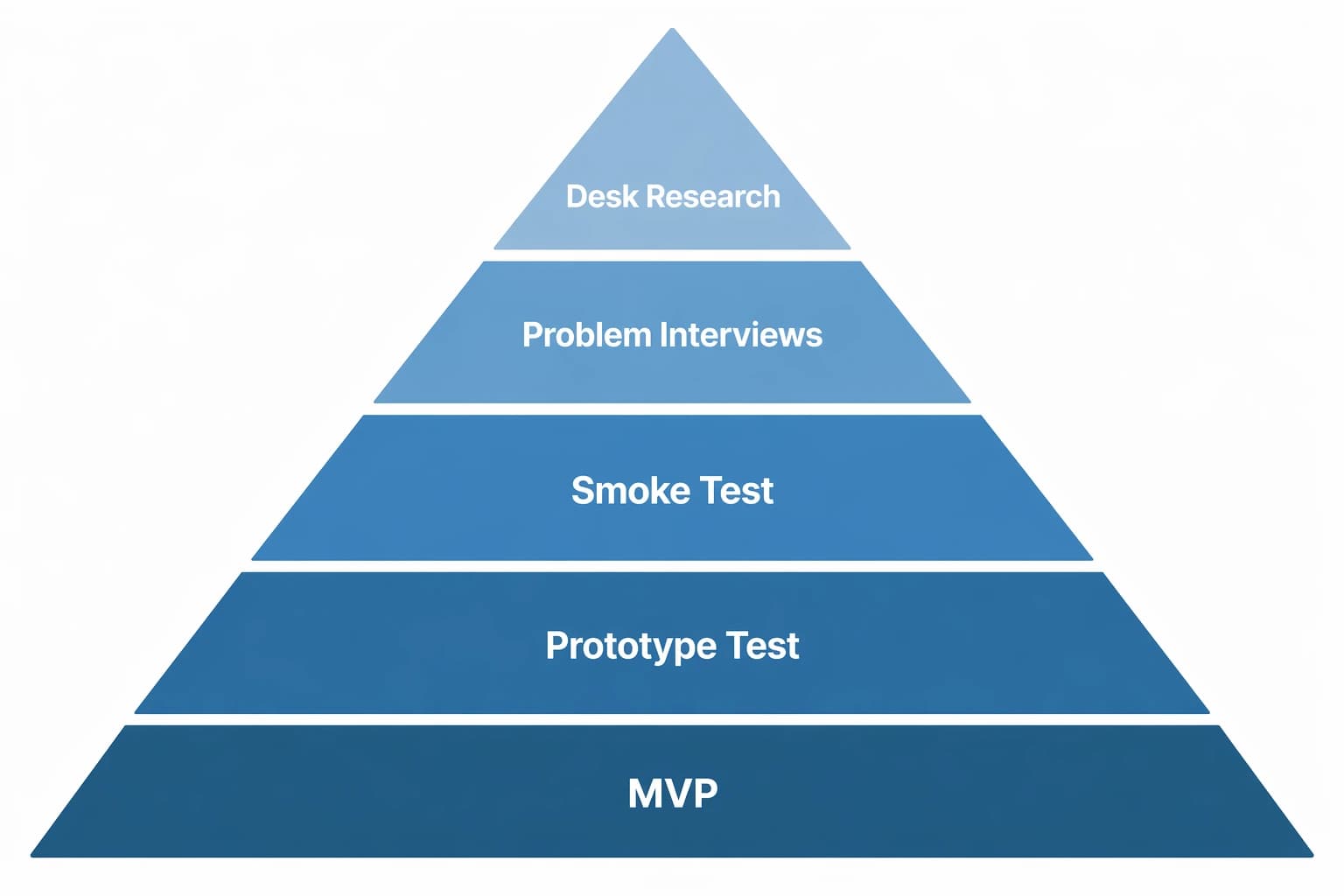
- The pyramid: 6 stages from desk research to MVP — the more expensive the stage, the stronger the signal.
- The Mom Test (Rob Fitzpatrick): ask about concrete past behavior, never hypothetical futures.
- Product-market fit starts at 40% "very disappointed" in the Sean Ellis test. Below that: keep iterating.
What does "validate" really mean?
Validating a business idea means systematically proving that real people are willing to pay for your product — before you invest time and money building it. Not believing, not hoping, but knowing with data.
The hard filter: Likes, feedback from friends, and "sounds great" don't count. Validation only works when the other person sacrifices something — time, reputation, or money. Everything else is politeness.
What validation is not
- A poll in your LinkedIn timeline
- Asking family and friends if they like the idea
- Reading market research and extrapolating trends
- Building a finished product and hoping users show up
- A pitch deck praised by investors
What validation is
- A hypothesis-driven process with clearly defined success metrics
- Direct feedback from interviews with your real target audience
- Measurable behavior under realistic conditions (clicks, signups, purchases)
- Actual willingness to pay — pre-sales, deposits, subscriptions
- A learning cycle that sharpens the idea iteratively or honestly disproves it
The concept traces back to Eric Ries' Lean Startup principle of "validated learning" — and to Steve Blank's core insight: "Startups don't execute business models, they search for them." That's exactly what validation is — the search, before execution gets expensive.
Why 90% of startups fail, and how you won't
According to CB Insights, 43% of startups fail because of "no market need" — they build a product no one wants (431 post-mortems analyzed). Another 23% fail on missing product-market fit despite an existing market. Together, that's two out of three failed companies whose mistake could have been prevented with validation.
The most expensive project of your career: a perfectly built product nobody wants. Six months of development, €40,000 to €80,000 of investment, and after launch the realization: the target group exists, but the problem doesn't exist at the assumed intensity. Validation is the guard against exactly that trap.
Validation answers three questions before you write a line of code: Does the market actually exist? Would people use it? Would they pay for it? Three questions 90% of founding teams only ask after launch — when it's too late.
The Validation Pyramid: 6 methods from cheap to definitive
Validation isn't either-or. The best teams combine methods in ascending order — each level is more expensive, slower, and delivers stronger signals. Starting at level 6 (functional MVP) skips exactly the stages where learning is still cheap.
Level 1 — Desk Research (€0, 1–2 days)
Google search, Google Trends, Reddit, forums, industry reports. Do competitors already exist? Is demand for your keyword growing? Are real people publicly complaining about the problem? The cheapest hour in your entire project — and the one with the highest leverage.
Note: Tools: Google Trends, SimilarWeb, Reddit search, Statista, AnswerThePublic, G2 reviews of competitors.
Level 2 — Problem interviews using The Mom Test (€0, 1–2 weeks)
10 to 20 structured conversations with people from your assumed target audience. Not a survey, not a focus group — one-on-one conversations about their actual life. Goal: find out whether the problem exists, how urgent it is, and how affected people solve it today.
Note: See the separate "Mom Test" section below — the only interview framework that delivers in practice what it promises.
Level 3 — Smoke Test / Fake Door (€50–200, 3–7 days)
A simple landing page describing your product as if it already existed. A "Buy now" or "Get access" button leading to a waitlist. Combined with €50–100 of Meta or Google ads on your exact target audience. Result: hard data on click-through, signup rate, and payment-intent indication.
Note: A conversion rate above 15% from cold traffic is a strong signal. Below 5% means positioning or target group is off.
Level 4 — Concierge MVP (€0–500, 2–4 weeks)
You deliver your service manually — no automation, no product in the literal sense. Example: Food on the Table, a recipe app, started by having the founder personally walk each customer through the supermarket. Benefit: you learn the real pain points and language patterns of users before building anything.
Note: Perfect for services, curation, or consulting-adjacent products. Doesn't scale past customer 10 — which is exactly when you move to the next level.
Level 5 — Wizard of Oz MVP (€200–2,000, 2–4 weeks)
Similar to concierge, but the user doesn't know. From outside it looks like finished software — inside, you or a student are doing the work manually. Zappos started that way: the website looked like an online shop, but the founder bought and shipped every order from local stores.
Note: Ideal for AI or automation products where building would be expensive but user experience needs early testing.
Level 6 — Functional MVP (€2,000–20,000+, 4–8 weeks)
Actual software with minimal features. Only here begins what many founders wrongly treat as the starting point. A functional MVP only makes sense after levels 1–5 deliver positive signals — otherwise it's expensive blind building.
Note: Deeper dive on MVP definition, scope, and 6-step build: see our separate guide "What is an MVP?".
The 6 methods compared
| Level | Method | Cost | Time | Signal strength | Best for |
|---|---|---|---|---|---|
| 1 | Desk Research | €0 | 1–2 days | Low (interest) | Before any other step |
| 2 | Problem Interviews (Mom Test) | €0 | 1–2 weeks | Medium (problem urgency) | You don't know the problem precisely yet |
| 3 | Smoke Test / Fake Door | €50–200 | 3–7 days | Medium (buying intent) | Solution is clear, demand is not |
| 4 | Concierge MVP | €0–500 | 2–4 weeks | High (real service sold) | Services or manual processes |
| 5 | Wizard of Oz MVP | €200–2,000 | 2–4 weeks | High (user experience tested) | Software products before full build |
| 6 | Functional MVP | €2,000–20,000+ | 4–8 weeks | Very high (market feedback) | After positive level-1-to-5 phase |
Decision flowchart: Which method fits your idea?
Most articles list all methods and leave you alone. We don't. Here's the decision tree we walk through with every client in our Innovation Workshop:
Have you already spoken to at least 10 potential customers — who are not friends or family?
No → Start here: Level 2 problem interviews using The Mom Test. Anything else is building without data.
Yes → Next question.
Did those conversations confirm a real, urgent problem they're actively trying to solve today?
No → Pivot your idea or find another problem. An unvalidated problem means no market, however good the product.
Yes → Next question.
Do you have a clear solution idea with a defined feature scope?
No → Level 4 Concierge MVP: solve the problem manually for 5 to 10 customers. You'll learn the right solution before building.
Yes → Next question.
Can you represent the solution visually or as a clickable prototype in under a week?
No → Level 5 Wizard of Oz: build the frontend, simulate the backend manually. Test UX before automating.
Yes → Level 3 smoke test. Landing page with a buy-CTA, €50–200 ad spend on the exact target audience. Measure willingness to pay before level 6.
The decision tree doesn't replace good judgment — but it prevents you from skipping a step that would have cost you cheap learning.
The Mom Test: Interviews even your mother can't sugarcoat
Rob Fitzpatrick's "The Mom Test" is the only interview framework that systematically protects against founder self-deception. The premise: even your mother can't give you an honest answer about your idea — but she can answer your questions in a way that surfaces the truth anyway. The three rules:
Rule 1 — Talk about their life, not your idea
Keep the idea in your head. Ask about their daily routine, habits, recent frustrations.
Wrong: "Would you use an app that helps you cook?"
Right: "How did you decide what to cook last week? What annoyed you about it?"
Rule 2 — Ask about specific past behavior, not opinions about the future
"Would you" questions produce polite answers. "Did you" and "Have you done" questions produce facts.
Wrong: "Would you pay for this kind of solution?"
Right: "Have you ever bought something to solve this problem? What? When? How much?"
Rule 3 — Talk less, listen — and follow up twice
Founders talk too much. The most important insights live in the second and third answer to the same question. "Tell me more." "What did you do then?" "Why?"
10 questions for your first problem interview
- 01Describe the last typical day you dealt with problem X.
- 02How often does that happen to you?
- 03What have you done so far to solve it?
- 04If what you're using disappeared tomorrow — what would you do?
- 05How much time or money does this problem cost you per week?
- 06Have you actively searched for a better solution? Where?
- 07Have you ever paid for a solution in this space? What exactly?
- 08What annoys you most about current solutions?
- 09Who in your circle has the same problem?
- 10If you could invent your dream solution — what would it do?
Smoke test in practice: Landing page + €100 in ads = hard data
The smoke test is the most efficient validation method in 2026. In 3 to 7 days, for under €200, you get actionable data on willingness to pay. For context: according to the Unbounce Conversion Benchmark Report 2024, the median landing-page conversion rate is 6.6%, and 3.8% for B2B SaaS. Anything above that is a real signal. The full workflow:
Step 1 — Build the landing page in 2 hours
Use Framer, Carrd, Webflow — or, since 2026, AI builders like Lovable or v0. The page needs three things: the problem in your target audience's language, your solution in one sentence, and a clear CTA ("Buy now," "Get access," "Try for free").
Step 2 — Build the conversion target
The CTA leads to a second screen: "You're early — leave your email to be first in line." You capture the email. Alternative: a direct pre-order checkout with Stripe to measure real money. Both are valid — money is the stronger signal.
Step 3 — Run €100 of Meta ads
In Meta Ads Manager, target your exact buyer profile (industry, role, interests, behavior). Two or three ad variants, €100 budget across 5 days. Google Ads works as an alternative — more expensive but more precise for purchase keywords.
Step 4 — Read the numbers and decide
After 5 to 7 days you have clicks, signups, and (with pre-order) first payments. Compare against the benchmarks in the next section. Strong signals? Continue. Weak signals? Pivot or refine the hypothesis.
Skin in the Game: The commitment pyramid
Real validation only happens when the user sacrifices something. In ascending importance — the more the customer invests, the stronger the signal:
Email address
Shows interest, not buying intent. Valuable as a first filter, but never sufficient on its own.
Time (30-minute interview)
Whoever invests 30 minutes has real interest. You learn the problem deeply, but the purchase step remains open.
Reputation (referral in their network)
Whoever shares your product unprompted in their network is staking their reputation on it. Strong signal for product quality.
Money (pre-order, deposit, subscription)
The ultimate validation. A €50 deposit says more than 500 email signups. Those who pay, believe.
Rule of thumb: validation based only on email signups is an early signal — not confirmation. Validation showing real payments is confirmation — not an early signal anymore.
When is your idea validated? The hard numbers
Most articles stop at "try it and see." Here are the benchmarks we've pulled from our own projects and international startup literature — concrete numbers, not feelings:
Validation benchmarks at a glance
| Method | Weak | OK | Strong |
|---|---|---|---|
| Landing page — CTA click-through | < 5% | 5–10% | > 15% |
| Landing page — email signup rate | < 2% | 2–5% | > 5% |
| Problem interviews — same pattern | < 3 of 10 | 3–6 of 10 | > 6 of 10 |
| Pre-order / waitlist (€100 ad spend) | < 20 signups | 20–80 | > 100 |
| Concierge / Wizard of Oz | 0–2 paying customers | 3–5 | > 5 paying customers |
| Sean Ellis test (PMF) | < 20% | 20–39% | ≥ 40% "very disappointed" |
The Sean Ellis test is especially valuable: ask your active users how they would feel if your product disappeared tomorrow. The answer options: "Very disappointed" / "Somewhat disappointed" / "Not disappointed" / "No longer use it." If 40% or more answer "very disappointed," you have product-market fit. It's the hardest metric in startup land — and the only one Sean Ellis (the first growth hacker at Dropbox, LogMeIn, Eventbrite) considers reliable.
AI-powered validation in 2026: your unfair advantage
What took two weeks in 2020 takes two hours in 2026. The AI revolution has pulverized validation costs — but only for teams that know the new tools. Four levers we use daily in projects:
1. Landing pages in 2 hours with Lovable, v0, or Bolt
Describe your product in a prompt — the AI builder generates a production-ready landing page. Design, responsiveness, CTA, form. Take the output as a starting point and tweak for 30 minutes. In 2020 that would have cost a designer plus a developer. In 2026 it's €20 in a tool subscription.
2. Synthetic audiences with Custom GPTs
Before running real ads, simulate your buyer persona in a trained GPT. "You are a 42-year-old HR director at a mid-size company, budget holder, GDPR-sensitive…" Chat with the model, identify objections you hadn't thought of. No substitute for real interviews — but a free dry run that sharpens your messaging.
Important: synthetic users are a warm-up, not validation. They hallucinate preferences real humans don't have. Never use as the sole basis for a decision.
3. Interview analysis with Claude or ChatGPT
After ten interviews you have 10 transcripts at 30–60 minutes each. Instead of hand-coding, feed the transcripts into an LLM and ask for pattern extraction: commonly mentioned problems, language patterns, unexpected objections. What used to take two days takes 20 minutes — with better consistency.
4. Clickable prototypes with Figma Make or v0
A clickable prototype was a week of designer work in 2020. In 2026 you describe the screens as text, the AI builder generates the clickable flow. Ideal for level-5 Wizard-of-Oz tests or moderated user feedback.
The tools are powerful — judgment remains your job. AI accelerates what you already understand. If you feed unclear assumptions into an AI builder, you get a quickly built bad idea. The validation discipline doesn't change, only the execution.
If you land at the prototype step and aren't sure whether a clickable Figma prototype is enough or you really need code: decision matrix on clickable vs. code prototype — risk-based format choice in four minutes.
The 5 most expensive validation mistakes
"My friends love the idea"
Friends and family don't want to hurt you — they lie unconsciously. Your target audience is never your inner circle, however convenient the idea seems. Zero-value feedback.
Coding too early
The classic "I'll build the MVP first, then do marketing" is the most expensive sentence a founder can say. 90% of MVP failures could have been prevented by pyramid levels 1–3.
Validating the wrong problem
You found the solution before the problem. If no one is actively searching for your solution, the problem isn't urgent enough. Always validate the problem, not the product.
Not testing willingness to pay
Interest isn't purchase. 1,000 email signups don't mean 100 paying customers. Test money as early as possible — pre-order, deposit, at least a Stripe checkout with a "sold out" fallback.
Validating endlessly to avoid launching
Some founders validate forever because validation feels like progress while launching feels like risk. More than 14 days of validation per hypothesis is perfectionism. When the data is clear, decide — either way.
Validation checklist: Is your idea ready?
Copy this checklist. Before you spend a single euro on building the MVP, at least 6 of 8 points must be checked:
- We've spoken with at least 10 potential customers — none of whom are family or friends.
- We know exactly how these people solve the problem today and what it costs them (time, money, or both).
- We measured a click-through rate above 5% on a landing page from cold traffic.
- We generated at least 50 email signups or 5 pre-orders through targeted ads.
- We've heard at least one clear "no" — and understand why that person declined.
- We have a precise problem description that our interviews consistently confirm.
- We know at least three direct or indirect competitors and their weaknesses.
- We tested a payment — deposit, subscription, or pre-order — and know what people are willing to pay.
Fewer than 6 checks? Go back to pyramid levels 1 through 3. The checklist isn't a hurdle — it's the wall between you and the most expensive project of your career.
How decivo helps you validate
We're a boutique studio with a clear guiding principle: Clarity Before Code. Our clients come to us before spending €40,000 to €80,000 on an MVP — and learn in a few weeks whether the idea holds up. Our modules cover exactly pyramid levels 2 through 5:
Level 2 + Scoping
Innovation Workshop — €7,500
We structure your problem, research the market with AI-powered methods, and deliver a clickable prototype at the end. After the workshop, you know what to build — and, just as important, what not to.
Level 5 precursor
Clickable Prototype — €3,500
An interactive Figma prototype that makes your product tangible. Ideal for user interviews, pitch meetings, or smoke-test landing pages with real screens.
Level 5
UX Validation Loop — €1,350 / loop
Real users test your prototype in unmoderated sessions via Maze. We deliver structured analysis and actionable recommendations. Data-driven judgment instead of gut feeling.
Level 6 entry
Code Prototype — €12,500
Functional core features live. Only after positive validation on lower levels — otherwise we build blind and waste your money.
Our difference from classical MVP building: We never start with code. Every project at decivo begins with the Innovation Workshop and runs through the packages in ascending depth. Only after levels 2 through 5 deliver clean signals do we build in the Code Prototype. Clients who arrive with an unvalidated idea leave the workshop either with a validated thesis — or with the honest insight that the idea needs rebuilding.
Exception: if you already have a finished, clickable prototype from your own design team, we start directly at UX Validation and iterate toward the Code Prototype. No duplicated work.
Want to test whether your idea is ready for a validation workshop? Book a free 30-minute call — together we'll place which next step makes sense. No sales pressure. No obligation.
Sources
Every figure in this article comes from the publications below. Where we use our own data, the study is named in the text.
What you should know about validation
How long does validation take?
Core validation fits into 7–14 days with focus: 3 days of problem interviews, 2 days to build the landing page, 7 days of smoke-test ads. Teams that take longer usually fall into perfectionism or test the wrong assumption.
What does it cost to validate a business idea?
Between €0 and €2,000 depending on method. Problem interviews and desk research cost nothing. A smoke test with landing page and ads is typically €50–200 in ad spend. A concierge or Wizard-of-Oz MVP usually stays under €2,000. Spending more means you're already building, not validating.
How many interviews do I need?
Rule of thumb: 10–20 problem interviews per target segment. After 15–20 conversations you will hear the same patterns. If the pattern stays fuzzy after 20, your segment is too broad or the problem isn't concrete enough.
Can I validate a business idea without coding?
Yes. Most validation methods need zero code. You build a landing page with Framer, Carrd, or Webflow in two hours. Ads run through Meta Ads Manager. Interviews happen via Calendly and Zoom. In 2026, AI builders like Lovable or v0 let you ship functional prototypes without any coding.
What's the difference between validation and MVP?
Validation is the process — an MVP is one possible tool for it. You can validate without ever shipping an MVP (interviews, landing pages, pre-sales). The MVP is level 6 of the validation pyramid: expensive and slow, but with the strongest market signal. Starting with an MVP skips all the cheap learning stages.
When is an idea considered validated?
When three signals align: (1) more than 15% click-through on the landing-page CTA from cold traffic, (2) at least 5 paying customers in a concierge or pre-sale setup, (3) 40% or more of users in the Sean Ellis test would be "very disappointed" without your product. Less is signal, not certainty.
Should I keep my idea secret until I've validated it?
No. Ideas without execution have no value, and secrecy prevents exactly the feedback you need. Exceptions: patentable technology or B2B deals with NDAs. Otherwise, the more people who know and challenge your idea, the better it gets.
What do I do if validation fails?
That's the most valuable outcome. You just saved tens of thousands of euros and six months. Diagnose systematically: wrong target group, problem too small, unfit solution, or unclear communication? A pivot on one of those four axes is often enough — the real problem stays, but the product changes fundamentally.
Related articles
- MVP basics
Clickable Prototype or Code Prototype? Decision Matrix for Founders 2026
Clickable Figma prototype or working code? Risk-based matrix, five anti-patterns, and clear guidance on which format answers which question — from a studio that ships both.
- MVP basics
What is an MVP? Definition, Examples & Step-by-Step Guide
MVP explained: What a Minimum Viable Product really is, why it doesn't mean 'half-finished', and how to build your own MVP in 6 steps — with real examples from Dropbox to N26.
- Building an MVP
What Does an MVP Cost? Having an MVP Built in 2026: Real Prices, Not Ranges
The AI price break: why MVPs are cheaper in 2026 than 2024, traditional agency vs. AI-native studio per MVP type, published fixed prices instead of hourly ranges — plus an interactive cost calculator.