Is AI-Generated Code Production-Ready? What the 2026 Studies Actually Say
“Couldn’t I just build this with AI?” Yes. Probably. And that’s exactly why it’s no longer the interesting question. The better question: can you actually keep building on it afterwards? Here is the complete body of evidence — no hype, no panic.
No — not automatically: in 2026, AI-generated code is over 95% syntactically correct, but passes basic security checks in only about 55% of cases (Veracode, 150+ models tested). In our own Vibe-Code Audit, 12 typical MVP features generated with a naive one-shot prompt met only 19.6% of production-readiness controls in chat coding — and even with the newest agentic model (OpenAI Codex) only 47.1%; in both cases 0 of 12 features were fully ready. AI code becomes production-ready through what models don’t deliver: architecture review, security hardening (Row Level Security, auth, input validation) and tests — owned by humans.
TL;DR — the 7 numbers
- Our own measurement (decivo Vibe-Code Audit): 12 MVP features from a naive prompt meet only 19.6% of production-readiness controls in chat coding, 47.1% with the newest agent (Codex) — 0 of 12 fully ready; authorization, validation and tests stay at zero in both.
- 45% of all AI coding tasks introduce a known security flaw — a figure that has stagnated for two years despite better models (Veracode, 80 tasks, 150+ LLMs).
- Over 95% syntax correctness vs. ~55% security pass rate: visible progress and technical progress are measurably drifting apart.
- Duplicated code blocks are up 8×; the share of refactoring fell from ~25% to under 10% (GitClear, 211M lines of code).
- Experienced developers were 19% slower with AI tools — while believing they had been 20% faster (METR, randomized controlled trial).
- 66% of developers name “almost right, but not quite” as their top problem; only 29% still trust AI output (Stack Overflow, 49,000+ respondents).
- 170 of 1,645 scanned Lovable apps exposed emails, payment data or API keys — missing Row Level Security (CVE-2025-48757).
“Couldn’t I just build this with AI?” Yes.
We hear this question in almost every first call. The honest answer: yes, probably. Since Andrej Karpathy coined the term vibe coding in February 2025, a meme has turned into a working mode: in Y Combinator’s W25 batch, a quarter of startups had codebases that were roughly 95% AI-generated — and those were technical founders.
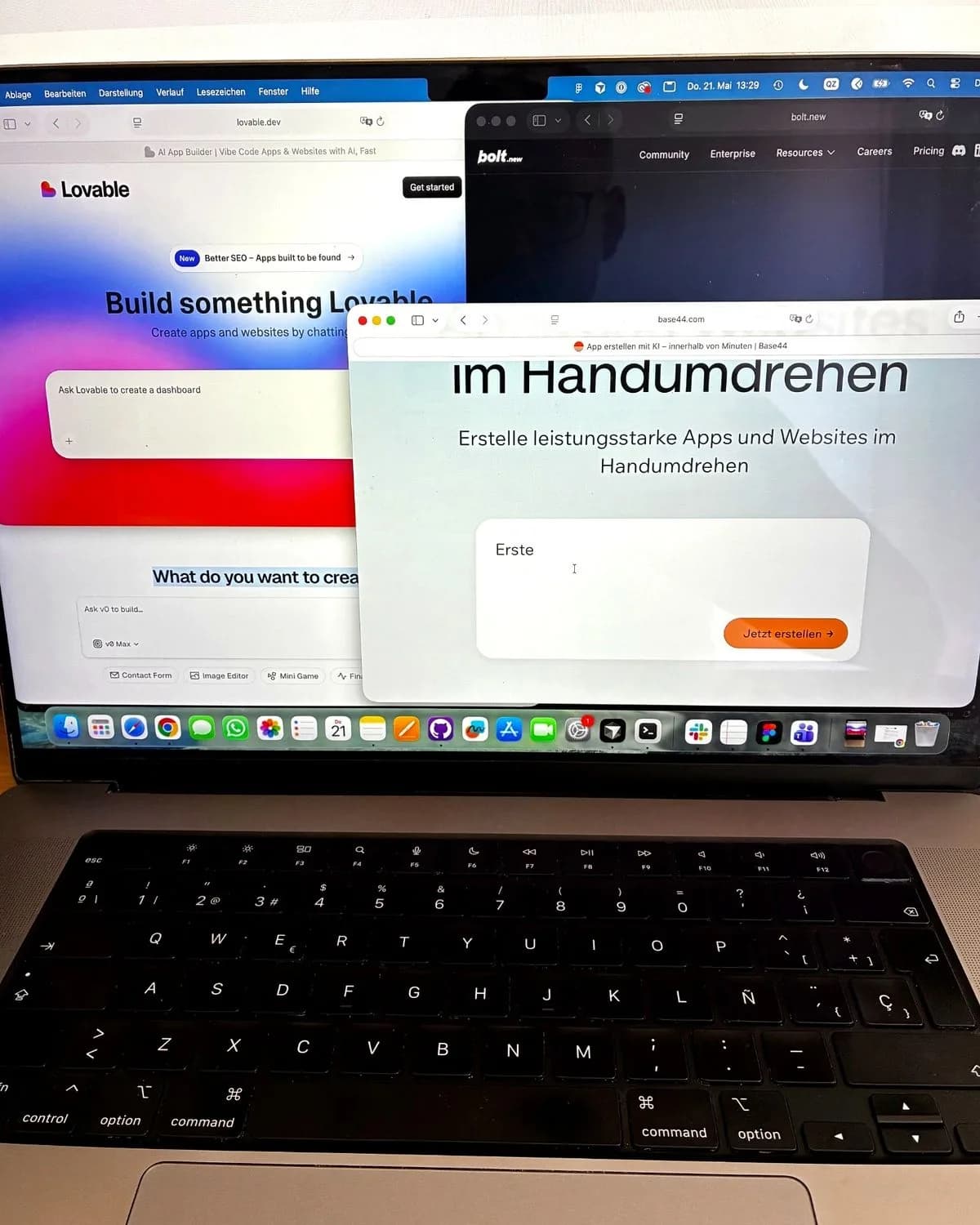
A dashboard. A login. A database. A few workflows. A beautiful UI. Lovable, Bolt, v0 or Claude Code generate all of that in hours instead of weeks today. Which is exactly why “can AI build this?” is no longer the interesting question.
The better question: can you actually keep building on it afterwards? Not as a demo. Not as a pitch link. But as an MVP that real development can continue on. That’s where the data comes in — and in 2026 it is remarkably consistent.
The 2026 evidence at a glance
Six independent studies plus our own measurement, one consistent picture: AI-generated code works — and still needs systematic rework before it can carry production.
| Study | Key finding | Data basis |
|---|---|---|
| Veracode GenAI Code Security (2025 + 2026 update) | 45% of tasks introduce a known vulnerability; security pass rate stagnates at ~55% | 80 coding tasks, 150+ LLMs |
| GitClear AI Code Quality 2025 | 8× more duplicated code blocks; refactoring share fell from ~25% to under 10% | 211M changed lines of code (2020–2024) |
| METR experiment (July 2025) | Experienced developers 19% slower with AI — while feeling +20% faster | 16 maintainers, 246 real tasks, randomized |
| Stack Overflow Developer Survey 2025 | 84% use AI, but only 29% trust it; 66% name “almost right” as their top frustration | 49,000+ developers worldwide |
| Fastly Developer Survey 2025 | Nearly 30% of senior devs: rework eats most of the time saved | Developer survey, US |
| Lovable RLS scan (CVE-2025-48757) | 170 of 1,645 scanned apps exposed personal data | Scan of the public Lovable showcase, May 2025 |
| decivo Vibe-Code Audit (2026, our own study ↓) | Chat coding 19.6%, agent (Codex) 47.1% of controls met; 0 of 12 features ready | 12 one-shot features × 2 models, semgrep + open checklist |
Rows 1–6 come from the respective original publications (source list at the end). Row 7 is our own reproducible measurement — details below.
Visible progress is not technical progress
The most important number of the year sits in Veracode’s spring 2026 update: the tested models now achieve over 95% syntax correctness — the code runs, the demo shines. At the same time, the security pass rate remains unchanged at around 55%. For two years. Across several model generations.
That is the measurable version of a feeling many founders know: AI tools are incredibly good at producing visible progress. But visible progress is not automatically technical progress. What looks like an MVP is sometimes a very convincing throwaway prototype: works for you, right now, today — but carries no real further development.
The difference is real money. A prototype you can build on is a living specification and lowers the cost of the production version. One you can’t build on is a second project budget with lead time. Which of the two you have is revealed by the Build-On Test below.
What goes wrong immediately: security
Veracode tested more than 150 models against 80 realistic coding tasks. Result: in 45% of cases the model chooses the insecure variant even though a secure one exists. For cross-site scripting the failure rate is 86%; in Java, models fail 72% of tasks — reproducing the insecure legacy patterns they were trained on.
CVE-2025-48757 shows what that looks like in practice: a security researcher scanned 1,645 publicly showcased Lovable apps — 170 of them exposed email addresses, payment information or API keys. The cause was almost always the same: missing or misconfigured Row Level Security in the database. The apps looked finished. They weren’t.
This is not a Lovable problem, it’s a pattern: AI optimizes for “works in the demo”, not for “withstands an attacker”. Security decisions — role separation, access rules, input validation — must therefore never be made automatically. They are made and reviewed by a human before the first real user enters their data.
What goes wrong slowly: maintainability
GitClear analyzed 211 million changed lines of code from 2020–2024. The share of refactoring — cleaning up, consolidating, reusing code — fell from around 25% to under 10%. Duplicated code blocks increased eightfold. In 2024, for the first time, more code was copy-pasted than moved.
Why this matters: duplicated code is the interest rate on technical debt. Every copied piece of logic has to be maintained in several places on every change — and that is exactly where the bugs emerge that only surface after launch. A codebase another team can open without immediately wanting to start over doesn’t come from more prompts. It comes from architecture decisions.
That’s why our rule is: AI-generated code is a starting point, never production. What comes out of a builder gets re-implemented against a documented architecture — with a clean data model and traceable logic. What that path looks like in practice is covered in our guide Vibe coding: from prototype to product.
The productivity paradox
Perhaps the most uncomfortable study of 2025 came from METR: in a randomized experiment, 16 experienced open-source developers completed 246 real tasks — sometimes with, sometimes without AI tools. With AI they were 19% slower. Their gut said: 20% faster.
The same pattern at scale: 84% of developers use AI tools, but trust fell to 29%. 66% name solutions that are “almost right, but not quite” as the biggest problem — and 45% say debugging AI code takes longer than writing it themselves (Stack Overflow, 49,000+ respondents). At Fastly, nearly 30% of senior developers report that rework eats most of the time saved.
Does that mean AI isn’t worth it? No — it means the leverage sits elsewhere than the marketing promises. Standardisable work (UI building, CRUD, scaffolding) becomes drastically cheaper with parallel agents; security- and architecture-critical work barely does. We broke down exactly this asymmetry in What does an MVP cost? — it is the reason MVPs are cheaper in 2026 without responsibility having become any cheaper.
Our own study: the decivo Vibe-Code Audit
Third-party studies are good — a reproducible measurement of your own is better. So we tested this article’s thesis ourselves: we had 12 typical MVP features (upload, contact form, comments, password reset, admin list, search, API-key storage, Stripe webhook, profile edit, file download, orders API, newsletter) generated with a single naive one-shot prompt each — exactly how a founder types it into an AI tool. No prompt said “secure”, “validation” or “test”.
We ran it in two modes: once like classic chat coding (where most people start — naive prompt, answer in the chat) and once with an agentic coding tool (OpenAI Codex, model gpt-5.6-sol) that writes the AI code straight to files. So we compare the mode, not model against model. Every output was checked against the Build-On Test controls, with semgrep as an independent detector plus an open checklist. The result:
Chat coding vs. agentic coding agent
| Mode | Production readiness | Controls | Fully ready | semgrep findings |
|---|---|---|---|---|
| Chat coding | 19.6% | 10 / 51 | 0 / 12 | 3 (XSS, mass-assign, IDOR) |
| Agent (Codex gpt-5.6-sol) | 47.1% | 24 / 51 | 0 / 12 | 0 |
Agent closes
The agent fully closes the generic hygiene layer: Row Level Security, injection safety, error handling and secret storage jump from patchy to 100% each. The three syntactic semgrep findings disappear. Agentic coding is a real step up from chat coding.
Zero in both modes
But exactly the controls that would need to know your business rules stay at zero in both modes: authorization 0/7, input validation 0/7, tests 0/12, webhook signature 0/1. No model adds them, because the naive prompt never states who may do what or what counts as valid.
This is the real proof of a specification deficit, not a capability deficit: where the requirement is generic and implicit (use RLS, escape HTML), the agent fills it. Where it would have to know your product (may this user see this order?), even the frontier agent leaves it blank. Both modes produce running code — and not a single production-ready feature. That is exactly what “visible progress ≠ technical progress” means.
A transparency note, because citable research states its limits: two models, one run each, N = 12, one-shot — a reproducible pilot benchmark, not population statistics. Prompts, raw code, semgrep rules, the scoring script and both result datasets are fully disclosed (CC BY 4.0); rebuilt with any further model, the same methodology yields a directly comparable number.
The Build-On Test: 5 questions for every AI prototype
Whether an AI-built prototype is an MVP foundation or a throwaway prototype comes down to five questions. If you can answer all five with a yes — verifiable, not felt — you can keep building.
1.Does the architecture hold up?
Is there a documented data model and a clear data flow — or is the structure whatever the tool happened to produce? Without an architecture anchor, every new feature costs more than the last.
2.Is the business logic clean?
Does the core logic live in one place, tested and traceable — or spread across components, copied and implicit? The GitClear finding (8× more duplication) is born exactly here.
3.Are data and roles properly separated?
Who may see, change, delete what — and is that enforced in the database (Row Level Security) rather than just hidden in the UI? That was the gap behind CVE-2025-48757.
4.Can the decisions be explained later?
Can you justify to an investor, an auditor or the next developer why the system is built this way? “The AI did it that way” is not an answer that survives due diligence.
5.Can the code be handed over?
Can another team open the code and keep working without wanting to start over? That is the hardest test — and the only one that decides the value of the work you’ve done so far.
Two or three no’s are not a death sentence — they just mean: the prototype is a specification, not a foundation. That is still valuable. But it is a different budget and a different plan.
Accelerator, not autopilot: how we use AI at decivo
Our goal is not to argue against Lovable, Bolt or v0. These tools show how quickly ideas can become visible today — and we use AI ourselves in every phase. The difference is the mode: AI as an accelerator, not as an autopilot. Every important step is reviewed by an expert — starting at the innovation workshop, not just in code review.
Concretely, that means: architecture before implementation. Row Level Security as the default, not an afterthought. Tests before code. And a documented contract AI agents are allowed to build against — in parallel and fast, but never unsupervised. That is how you get what the 45% statistic doesn’t deliver: code someone takes responsibility for.
If an idea is meant to become a real product, “AI built it” is no longer enough. What counts is whether you can keep building on it. The complete path from idea to launch is in Building an MVP with AI; the options for existing prototypes are in Lovable alternatives. Whether your prototype is secure and production-ready, you can check for free in the Rescue Scan.
Sources & studies
All figures in this article come from the following original sources. As of July 2026.
- Veracode — 2025 GenAI Code Security Report (80 Tasks, 100+ LLMs)
- Veracode — Spring 2026 GenAI Code Security Update
- GitClear — AI Copilot Code Quality 2025 (211 Mio. Code-Zeilen)
- METR — Measuring the Impact of Early-2025 AI on Experienced Open-Source Developer Productivity
- Stack Overflow — 2025 Developer Survey: AI
- Fastly — Senior Developers Ship 2.5× More AI Code (2025)
- TechCrunch — A quarter of startups in YC’s current cohort have codebases that are almost entirely AI-generated (März 2025)
- NVD — CVE-2025-48757 (Lovable / Row Level Security)
- Andrej Karpathy — Original „Vibe Coding“-Post (Februar 2025)
- decivo — Vibe-Code-Audit v1.0: Methodik & Datensatz (CC BY 4.0)
“Couldn’t I just build this with AI?” Yes. The question that counts in 2026: does the result pass the Build-On Test? We’ll take an honest look →
AI-generated code: frequently asked questions
Is AI-generated code secure?
Not automatically. According to Veracode, AI-generated code introduces a known vulnerability in 45% of tasks — a figure that has stagnated for two years across model generations. AI code becomes secure through the same measures as human code: security review, access rules enforced in the database (Row Level Security), input validation and automated scans — owned by someone who understands the risks.
Can you build a real product with Lovable, Bolt or v0?
As a prototype and living specification: yes, excellently. As a production system only with rework: the scan behind CVE-2025-48757 found openly retrievable personal data in over 10% of publicly showcased Lovable apps, mostly due to missing Row Level Security. If you want to launch, you need at least a security and architecture review — realistically a clean re-implementation of the critical paths.
What is a throwaway prototype?
A prototype that looks convincing and works in the demo but cannot carry further development: no documented data model, duplicated logic, no enforced access rules, not handover-ready. It is not worthless — as a specification and validation tool it is actually very useful. It just isn’t a foundation. Treat it like one and you pay the second budget later.
How do I know whether I can keep building on my AI prototype?
Use the Build-On Test with five questions: Does the architecture hold up (documented data model)? Is the business logic clean and in one place? Are data and roles separated in the database (Row Level Security)? Can the decisions be explained later? Can the code be handed over to another team? Only if all five get a verifiable yes do you have an MVP foundation — otherwise a valuable specification.
Does AI really make software development faster?
It’s nuanced: in METR’s randomized experiment, experienced developers were 19% slower with AI tools even though they felt 20% faster. At the same time, standardisable work — UI building, CRUD, scaffolding — becomes drastically cheaper with parallel coding agents. The net effect depends on whether a human with judgement decides where AI builds and where it doesn’t.
What does it cost to make an AI prototype production-ready?
It depends on how many questions of the Build-On Test it passes. As a living specification, a working prototype significantly lowers the cost of the production version, because discovery and scope clarification are already done. A typical web-app MVP built AI-natively sits at around €12,500 fixed price — the full breakdown including a cost calculator is in the article “What does an MVP cost?” on decivo.de.
Will AI replace development agencies and developers?
It shifts the work. Implementation gets cheaper — responsibility doesn’t: architecture, security, explainability and sign-off remain human tasks, and according to the evidence that is exactly where production-readiness is decided. In 2026 the winners aren’t those who avoid AI or use it blindly, but those who use it with a review structure.
Related articles
- AI code quality
Vibe Coding: From Prototype to Product 2026. What Comes After the First Prompt
Vibe-code MVP works but the code is chaos? 4-stage maturity scale, Stack of Truth, Clarity Retrofit workflow with prompts, before/after code, and 3 paths to production-grade software.
- AI code quality
Lovable Alternatives 2026: An Honest Comparison + What Actually Helps
Four categories of alternatives — from Bolt.new and Cursor to a Lean Software Studio. With a decision guide, real costs, and the honest question: tool problem or skill problem?
- Vibe Code Rescue
Lovable app not working anymore? The honest emergency guide
Your Lovable app breaks on every click and the AI agent makes it worse? Why it happens, what you can check yourself in 5 minutes, and when a rescue beats a rebuild — with the numbers from 1,072 scanned apps and a free scan.
Does your prototype pass the Build-On Test?
Show us your AI prototype — we’ll take a look and tell you honestly whether you can keep building or what’s missing. Even if the answer is: “All good, carry on.”
Clearly structured. No sales pressure. An honest assessment.