Where to Find Agencies That Build MVPs
An honest guide through the MVP agency jungle: which provider types actually exist, where to find them, what they really cost — and how to spot red flags before you sign. No top-list promo, no sales pitch.
You don't find an MVP agency through rankings but through three tests: does it quote a fixed price for a clearly bounded scope? Do you get the repository and the accounts from day one? And does it tell you what not to build? Anyone billing by the hour, holding the code in their own accounts, or saying yes to every feature idea is selling their own utilisation — not your product.
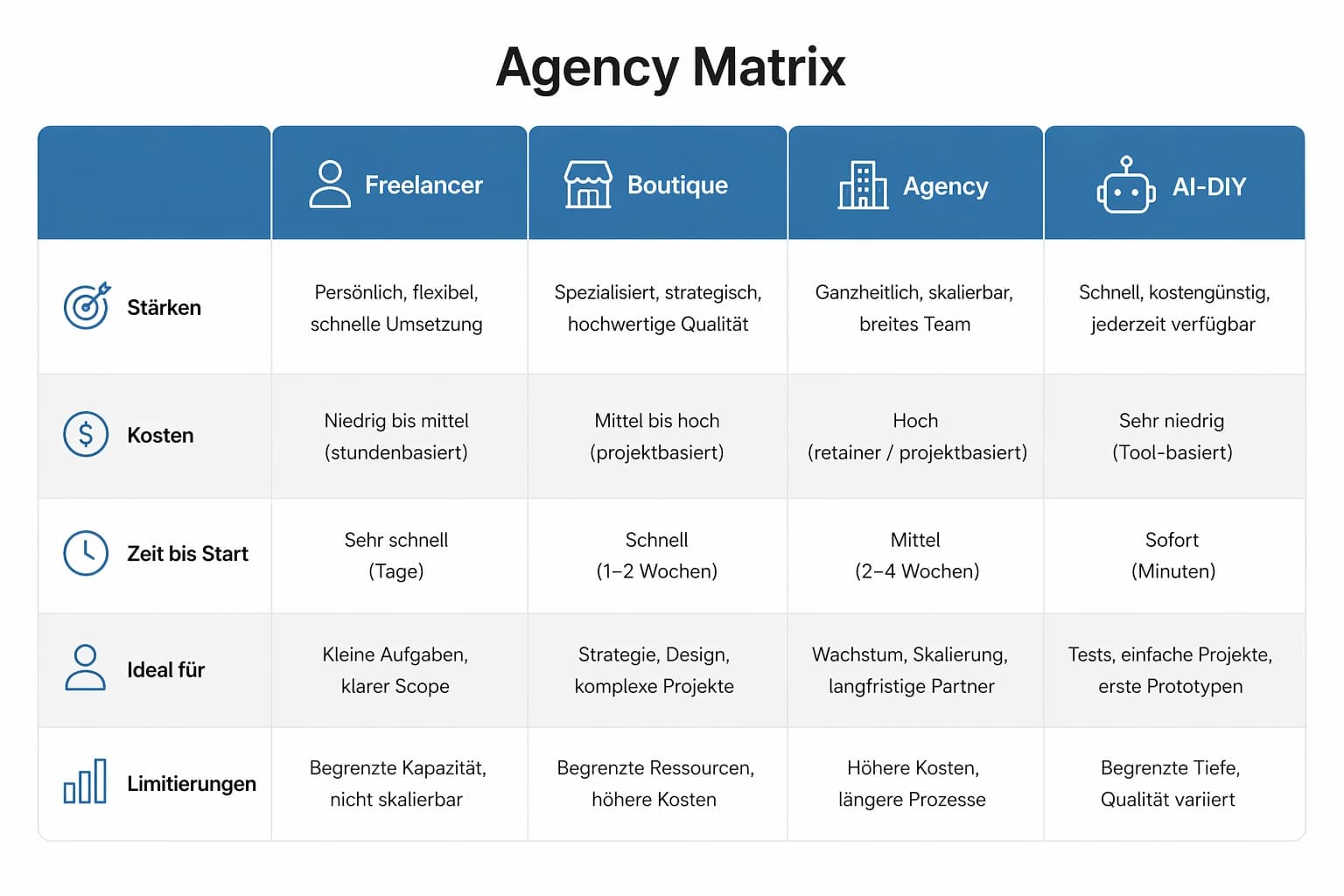
TL;DR — the 5 key points
- DACH senior freelancer rate: €105/h (Freelancer-Kompass 2025). Agencies cost more — we show when the premium is justified.
- Clutch average project: $132,480 over 13 months. An MVP must be a fraction of that — otherwise it's not an MVP.
- 2025 AI tool adoption: 84% of developers (Stack Overflow). If an agency still brags about this, they're three years behind.
- GDPR reality: EDPB requires technical measures for US cloud. Ask where your data lives.
- Red flags, green flags, and the 10 questions for your first call — all in this guide.
Do You Even Need an Agency?
Before we dive in, the unpopular question: do you actually need an agency for your MVP? In 2026 it's no longer a given. With AI app builders like Lovable, Bolt.new, or v0, non-technical founding teams can ship a working MVP in days — for under €100 per month.
The honest answer depends on three things: your goal, your time, and how much you trust your own technical judgment.
Context: Bitkom's 2025 report finds 64 percent of German companies see themselves as digital laggards, with 88 percent naming data protection as the biggest hurdle. Translation: MVPs built today land in a market with clear pain — but also with high bars for legal certainty.
When you don't need an agency
- —You want to test an idea solo — no product sparring, no UX research, no outside perspective
- —You have some technical fluency or want to build it
- —Your requirements are well-scoped and standard
- —You have time to learn and iterate yourself
- —Your total budget is under €3,000 — even single modules at boutique studios aren't realistic there
When a partner makes the real difference
- —You have critical business logic that's expensive to get wrong
- —You want investable code, not a no-code construct
- —GDPR, payments, or regulated requirements are in play
- —UX quality is a competitive advantage for you
- —You want strategic judgment — not just execution
Still unsure what exactly counts as an MVP? Our MVP guide covers the definition, boundaries, and six steps to your own MVP.
The 4 Partner Types Compared
“MVP agency” is not a clearly defined term. Behind that label you'll find four fundamentally different types of providers — with completely different prices, workflows, and outcomes. Miss that distinction and you pay twice.
1. Classical Agency
Large teams (10–100+), mature processes, account managers, compliance-ready. Perfect if you work in an enterprise context or need formal SLAs. But: Rarely optimized for lean MVP speed. You pay for process overhead, not product iteration.
2. Boutique Studio
Small, specialized teams (2–10) laser-focused on prototyping, MVP development, and early product validation. Direct line to the team, no account layer in between. This is where most of the money-for-value in 2026 lives.
3. Freelancers & Collectives
Individual developers or loosely joined groups. Great for well-scoped features or when you want to own the product layer yourself. Cheap, fast, but risky: vacation, illness, or project dropout are recurring pain points.
4. AI-DIY (Do-It-Yourself with AI Tools)
The 2026 newcomer. You build it yourself with Lovable, Cursor, or Claude Code. Incredibly cheap, incredibly powerful — but only if you bring product judgment. AI builds what you describe. Bad requirements produce bad apps.
Side note: according to the Stack Overflow Developer Survey 2025, 84 percent of developers already use AI tools daily. An agency that still sells this as a differentiator in 2026 is three years behind.
Side by side
| Type | Team size | Typical budget | Time to MVP | Control | Best for |
|---|---|---|---|---|---|
| Classical Agency | 10–100+ people | €30,000–€150,000 | 3–6 months | Low (process-heavy) | Enterprise, compliance-driven projects |
| Boutique Studio | 2–10 people | €15,000–€50,000 | 4–10 weeks | High (direct contact) | Startups, scale-ups, first MVPs |
| Freelancer / Collective | 1–5 people | €5,000–€25,000 | 2–8 weeks | Medium (varies) | Well-scoped features, prototypes |
| AI-DIY (Solo Founder) | You + AI tools | €0–€200/month | Hours to weeks | Maximum | Validation, technical solo founders |
5 Channels to Find MVP Agencies
Googling alone doesn't cut it — the first hits for “MVP agency Germany” are usually sponsored top lists that have more to do with SEO than quality. Here are the five channels that actually work in 2026:
1. Specialized B2B Platforms
Clutch, Sortlist, and GoodFirms are the three major directories where clients leave genuine reviews. Filter by country, focus on “MVP Development”, and team size. Note: Clutch verifies reviews via phone interviews — which filters out a big chunk of the fake reviews you see on other platforms.
2. LinkedIn, Done Right
LinkedIn is the best source for strong boutique studios in 2026 — if you search well. Filter by “MVP Development”, read case studies, check who actually writes substantively. Tip: anyone posting thoughtful, domain-specific content regularly shows you for free how they think — before you ever reach out.
3. Founder Communities & Referrals
Bundesverband Deutsche Startups, Slack communities like OMR or ProductLeaders, local startup hubs and accelerators (e.g. UnternehmerTUM, Factory Berlin). A personal referral beats any top list because the referrer's own credibility is on the line.
4. Industry Events & Pitches
Slush, Bits & Pretzels, South Summit, local startup nights. Here you meet agencies that don't just polish their storefronts but show how they actually work. Anyone who dares stand on a stage usually has a portfolio that holds up under the lights.
5. GitHub, Dribbble & Technical Signals
A public GitHub repo from an agency says more than any case study. Clean open-source code, commit hygiene, documented architecture — that's the engineering layer you can verify yourself. Same for design: Dribbble, Behance, and published case studies show real work instead of sales pages.
What an MVP Agency Really Costs
2026 is a turning point for pricing. The AI revolution has drastically lowered development costs — but not every agency passes those savings on to clients. Here are the honest numbers:
For reference: senior IT freelancers in the DACH region earn an average of €105 per hour in 2025 (Freelancer-Kompass). On the agency side, Clutch reports an average project of $132,480 over 13 months — an MVP that grows to that size has stopped being an MVP by definition.
Three cost truths nobody tells you:
The hourly rate is misleading
An agency at €150/h that ships your MVP in 4 weeks is cheaper than a €80/h freelancer who takes 4 months. Think in project bundles, not hours.
“Fixed prices” at project level are usually negotiable
80% of agencies operate on indicative pricing. Anyone quoting you an all-in fixed price for the whole MVP without discussing project-level scope either wants a fast signature or has priced in an expensive buffer. Modular fixed prices per step (workshop, prototype, validation) are different: scope per module is standardized — transparency, not buffer.
AI has automated away half the work
A typical MVP that cost €60,000 two years ago lands at €15,000–€30,000 today — if the agency masters AI workflows. Agencies still charging 2024 prices either don't have a modern stack or are pricing in silence money.
The number isn't a guess: McKinsey puts GenAI productivity gains in software engineering at 20 to 45 percent, and GitHub Copilot research reports up to 55 percent faster implementation. Agencies that don't pass those savings on to you are still pricing last year's cost structure.
For a deeper dive into new AI-era cost realities, see our MVP Tools Guide 2026 — we compare every relevant AI builder and no-code platform.
10 Red Flags That Can Save You Tens of Thousands
If even two of these apply: walk. If three apply: stop talking to anyone at that agency. These aren't our rules — these are the patterns we see from founders who reach out to us after a failed collaboration.
All-in MVP quote — without a scope conversation
You get an all-in fixed price for the complete MVP, but nobody asks about your assumptions, audience, or validation goal. Modular fixed prices per step (workshop, prototype, validation) are a different story — they're transparent and a green flag, because each module has a clearly defined scope.
Code doesn't belong to you
Contract clauses that keep code ownership with the agency or grant exclusive licensing to their infrastructure — classic vendor lock-in.
References without contact details
Logos on the site aren't enough. Ask for two former clients you can call. Refusal means there's something to hide. One exception: young boutique studios may not yet have client references — there, the founders' personal portfolio, publicly visible work samples, a transparent process, and a traceable LinkedIn history count instead.
Marketing polish, no engineering depth
The website is gorgeous, but technical questions get answered with buzzwords. No CTO, no architecture doc, no GitHub presence.
No answer on GDPR & DPAs
Anyone who says “we'll handle GDPR later” has never legally shipped a project. Data processing agreement, hosting region, data flow — day-one questions.
Fixed price without a scope document
A fixed price is fair — but only if the scope is written down. Without a scope doc, a fixed price is a trap where every change becomes an expensive change request.
Sales pressure instead of clarity
“Only two slots left for Q2.” “This price is only valid today.” People who build pressure are selling — people who build clarity are delivering.
Unclear team assignment
In the sales call you talk to seniors; at kickoff you meet juniors. Ask explicitly: who will actually build this? Who is accountable when things break? What are their qualifications?
No exit or handover strategy
What happens at the end? Who operates the system? How do you hand over to our internal team? Agencies without a handover plan want you locked in long-term.
Price far below market — without explanation
A complete MVP for €3,000 is either a landing page or a future disaster. Individual modules (e.g. a validation sprint or a clickable prototype) can legitimately land in that range — that's transparent, not suspicious. For a full MVP package, though: overpaying is annoying, underpaying is often more expensive.
8 Green Flags That Signal a Good Partner
Positive signals are rarer but clearer: if you see four or more of these, you likely have a solid partner in front of you.
They ask more than they promise
The first call is about your problem, your market, your users — not their service catalog.
Clear code ownership — in writing
Source code, repository history, deployments — everything is yours after the project. In the contract. Not on the website.
Stack reasoning over stack religion
A good partner picks the stack for your project, not their comfort zone. And can explain exactly why.
Real case studies with numbers
“We built XYZ” is weak. “We built XYZ in 7 weeks for ~€25,000 with these three insights from user interviews…” is strong.
Validation before development
Anyone who starts coding immediately isn't working lean. Anyone who proposes a prototype, user interviews, and assumption tests first understands your risk.
Transparent prices and packages
Either public indicative pricing on the website or a clear scope-price matrix in the proposal. No “on request” fog.
Public thinking
Blog posts, LinkedIn, talks, open source — anything that shows how these people actually work and decide. Filters out marketing facades.
GDPR as a given, not an upsell
DPA arrives at kickoff. EU hosting is standard. Data flow is documented — without you having to ask.
10 Questions for Your First Discovery Call
Save this checklist and bring it into every first call. The answers reveal in 45 minutes whether you're sitting across from a partner or a salesperson:
01Who owns the code after the project ends?
Good answer: full usage rights including repository access. Bad answer: license model or “we'll figure it out later.”
02Which project in your portfolio is closest to ours — and what did you learn from it?
Good partners remember specific wrong assumptions, pivots, and learnings. Bad ones list logos.
03How do you define when our MVP is done?
Good answer: testable hypothesis + launch criteria. Bad: “when all features are in.”
04Who exactly from your team works on our project?
Names, LinkedIn profiles, role on the project. Sales senior isn't the same as project senior.
05Which tech stack do you recommend and why?
The reasoning matters more than the stack. Anyone who can't explain a decision hasn't really made one.
06How do you use AI tools in your development process?
Working in 2026 without Claude Code, Cursor, or GitHub Copilot is like working in 2010 without an IDE. Ask concretely.
07How does validation with real users work?
If the answer is “we'll do that after launch,” this agency builds features, not products.
08What happens after launch?
Operations, maintenance, handover to the internal team — all contractual before you start.
09Where is the data hosted and how does the GDPR process work?
EU servers, DPA, documented data flow. Anyone stumbling here has already lost in Germany.
10What would you tell us if you don't take this project on yourselves?
Honest partners can say no. Anyone who takes on every lead is optimizing utilization — not your success.
GDPR & Legal Essentials: The Must-Ask Questions
The German market is wonderfully lucrative — and unforgiving about data-protection mistakes. Your MVP will be taken offline faster than the first leads arrive if these points aren't airtight:
What most founders miss: the EDPB's Recommendations 01/2020 require supplementary technical measures (e.g. encryption with keys held outside the third country) for transfers to the US — Standard Contractual Clauses alone aren't enough. If your agency can't address this, you're shipping GDPR liability with every deploy.
Data Processing Agreement (DPA)
Between you and the agency, and with every tool provider that touches user data. No DPA, no project start.
EU data residency
Supabase Frankfurt, Vercel EU region, Hetzner — all possible. Outside the EU only with additional safeguards (Standard Contractual Clauses + risk assessment).
Code ownership and usage rights
Custom code is yours. Frameworks and libraries stay with their licensors. Sounds trivial, but without an explicit clause you're exposed.
Liability for data incidents
The DPA defines who is liable for what. Serious agencies carry professional liability insurance that covers these cases.
Exit clause & data handover
What happens to your data when you end the engagement? Exportable backups, clear deletion deadlines, handover protocol — all clarified before project start.
How decivo Positions Itself
Because honest transparency should be worth more than marketing spin: here's where we fit in this landscape — and where we don't.
We are a boutique studio
Two to four people per project, direct line to the founding team, no account layer in between. Our focus: prototyping, MVP development, and product validation across the DACH region. Nothing else.
Our stack: Clarity Before Code
We combine classical software craftsmanship with modern AI orchestration. Figma for clickable prototypes, Claude Code for autonomous feature building, Supabase for GDPR-compliant backends, Vercel for deployment, Linear for project management. No magic — just the consistent application of the best stack available in 2026.
What it costs
Our modules start at €1,350 (UX Validation) and go up to €12,500 (Code Prototype). A typical MVP in the boutique segment with us lands between €15,000 and €35,000 — and we pass AI savings on transparently instead of hiding them in the margin.
What sets us apart
- Code belongs to you. Always. Anchored in the contract.
- Validation before development — no feature without user feedback.
- GDPR and EU hosting as standard, not as upsell.
- Transparent module pricing on the website, no “on request”.
- No exclusivity clauses, no vendor lock-ins, no sales pressure.
If this sounds like a partner you'd want to work with: free 30-minute discovery call. If not: use the checklists above anyway. They'll save you the same headaches with any other provider.
Sources
Every figure in this article comes from the publications below. Where we use our own data, the study is named in the text.
- Computerwoche — Freelancer-Kompass 2025: IT-Freiberufler verdienen 105 Euro in der Stunde
- Clutch — Software Development Pricing
- GitHub — Quantifying GitHub Copilot's impact on developer productivity and happiness
- Stack Overflow Developer Survey 2025 — AI-Sektion
- McKinsey — The economic potential of generative AI
- Bitkom — Digitalisierung der Wirtschaft kommt langsam voran (2025)
- EDPB — Recommendations 01/2020 on supplementary transfer tools
What else you should know about MVP agencies
Where do you find MVP agencies in Germany?
The best channels in 2026 are specialized platforms like Clutch, Sortlist, and GoodFirms; targeted LinkedIn searches by case studies; referrals from founder communities (e.g. Bundesverband Deutsche Startups); pitch and tech events; and direct outreach to boutique studios with clear MVP specialization. Top lists online are often sponsored — always cross-check.
What does it cost to build an MVP with an agency?
Price ranges in 2026 vary widely: classical agencies €30,000–€150,000, boutique studios €15,000–€50,000, freelancers €5,000–€25,000. With modern AI workflows, many MVPs in the boutique range can now be delivered for €15,000–€30,000 — 40 to 70 percent cheaper than two years ago. What matters is not the price, but what you actually own afterwards.
Agency, freelancer, or AI-DIY — which is right for us?
Rule of thumb: just validating an idea with some tech literacy? Go AI-DIY with Lovable or Bolt. Need clearly scoped features implemented? Freelancer. Want a real partner for strategy, design, and engineering? Boutique studio. Enterprise needs with compliance, SLAs, and stakeholder alignment? Classical agency.
How long does an MVP take with an agency?
A focused MVP at an experienced boutique studio takes 1–10 weeks, depending on scope. Classical agencies typically need 3–6 months — most of it spent on process and coordination. AI-assisted boutique teams can genuinely ship small, tightly scoped MVPs inside a week. Be cautious though if someone promises a large, complex MVP in two weeks — that's usually a prototype sold as an MVP. Anyone quoting nine months has missed the lean idea entirely.
What red flags should I watch for when choosing an agency?
Key warning signs: fixed prices without a scope discussion, no code ownership for you, exclusivity clauses on the code, no verifiable references, more marketing polish than engineering substance, no answers on GDPR or data processing agreements, unclear handover at project end, scope-creep clauses, suspiciously low prices, and a sales process that builds pressure instead of clarity.
What should I ask in the first call with an MVP agency?
Ask concretely: Who owns the code at the end? Which tech-stack decisions do you make and why? What does your validation process look like? Which project in your portfolio is closest to ours — and what did you learn from it? Who from your team actually works on our project? How do you involve us in decisions? What happens after launch?
What is the difference between an MVP and a prototype?
A prototype tests an idea visually or interactively — often in Figma, sometimes clickable, usually without real code behind it. An MVP (Minimum Viable Product) is a working product with real logic, real users, and real data. Prototypes inform decisions; MVPs validate markets. Good studios build both, in the right order.
Who owns the source code after the MVP project?
This needs to be contractually clear before you sign. Industry-fair standard: the client receives full usage rights to the custom code, including repository access. Agencies that only license the code to you or lock it into their infrastructure create vendor lock-in. Code ownership is negotiable — but it should be a question you ask.
Does my MVP agency have to be based in Germany?
Not strictly, but there are good reasons: shared time zone for fast alignment, GDPR familiarity, shared business culture, no translation overhead for user interviews. Offshoring to Eastern Europe or Asia saves cost but often costs speed and quality in coordination. For a first MVP full of unproven assumptions, we recommend working in the same language and legal framework.
Can I build my MVP entirely without an agency in 2026?
Technically yes. With tools like Lovable, Bolt.new, Cursor, and Supabase, even non-technical founders can ship a working MVP for under €100/month. The catch: tool choice, UX decisions, architecture, and GDPR remain your job. Most solo projects fail not on the tech, but on missing product judgment. That is exactly why boutique studios like us exist: AI speed plus experienced judgment.
Related articles
- Building an MVP
What Does an MVP Cost? Having an MVP Built in 2026: Real Prices, Not Ranges
The AI price break: why MVPs are cheaper in 2026 than 2024, traditional agency vs. AI-native studio per MVP type, published fixed prices instead of hourly ranges — plus an interactive cost calculator.
- Building an MVP
MVP Tools 2026: The Best Tools Compared
No-code, AI app builders, Claude Code & Cursor — all MVP tools compared. Costs, workflows & decision guide.
- WordPress
WordPress maintenance: what your site really costs in 2026, and when moving becomes cheaper
Maintenance contract, plugin licences, hosting: a bilingual Elementor company site calculated with real list prices (around €1,360 to €1,390 a year). With a worksheet to fill in, seven questions for your maintenance contract and an honest answer on when to stay on WordPress.
Clarity before signing the contract
Now you know the partner types, what to watch for, and which questions make the difference. In a free discovery call, we honestly assess your project — even if we're not the right fit, you leave with a usable read.
Clearly structured. No sales pressure. Ready to start within days.